

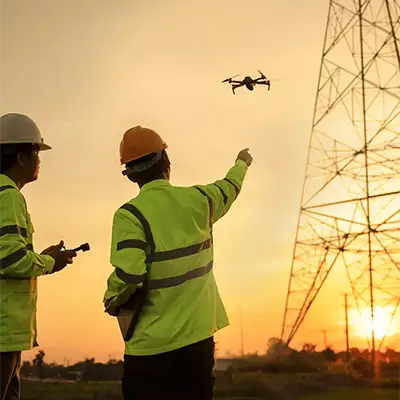


Enterprise Drones, Payloads, Accessories, and Software: A Complete Resource for Professional UAV Programs
DSLRPros is an enterprise drone dealer with over a decade of experience configuring aerial systems for inspection, public safety, precision agriculture, survey, mapping, autonomous operations, and government programs. This collection is the broadest view of what we carry: aircraft from DJI, Autel, Inspired Flight, ACSL, Freefly, WISPR Systems, and Vantage Robotics; payloads from MicaSense, Sentera, GreenValley International, Teledyne FLIR, Gremsy, and Deepthink; accessories including batteries, cases, controllers, and field tools; and software from PIX4D, Airdata, DJI, GreenValley, and FlytBase. If you are researching a specific product category, the sub-collections linked throughout this page cover each in full detail. If you are earlier in your research and want to understand how enterprise drone programs are structured and which components matter for which missions, this page is the right starting point.
What Is an Enterprise UAV and How Does It Differ from a Consumer Drone
An enterprise UAV is an aircraft designed for professional operational use rather than recreational flight. The distinction is not primarily about size or cost, though enterprise aircraft are typically heavier and more expensive than consumer models. The defining differences are in the systems that support sustained professional deployment: payload interfaces, transmission reliability, positioning accuracy, environmental protection, and the software ecosystem that processes and manages the data the aircraft collects.
A consumer drone is a self-contained imaging device. Its camera is integrated, fixed, and not upgradeable. It is designed to be flown by a single operator for relatively short periods and produces imagery that is stored and reviewed manually. A professional enterprise drone is a platform. Its imaging system is a separate payload that can be swapped between missions depending on what needs to be measured. Its positioning system includes RTK and PPK options that produce centimeter-level accuracy. Its transmission system covers several kilometers with stable video and telemetry rather than the hundred-meter range of consumer systems. Its software connects to fleet management platforms, mission planning tools, and data processing pipelines that turn raw flight data into actionable deliverables.
The practical consequence of this difference is that configuring an enterprise UAV program involves making decisions at three levels simultaneously: the aircraft, the payload, and the software. Getting one of those three wrong for a mission type produces a system that cannot deliver what the program requires, regardless of how capable the other two components are.
The Three-Layer Stack: Aircraft, Payload, Software
Every professional drone deployment is built around the same three-layer architecture. Understanding each layer is essential for evaluating whether a proposed system will meet a program's operational requirements.
The aircraft layer determines how far the drone can fly, how long it stays in the air, how much it can carry, what environmental conditions it can operate in, and whether it can fly autonomously from a dock or only with a pilot in the loop. Aircraft decisions involve platform selection (what manufacturer and model), configuration (what battery, controller, and mounting hardware), and regulatory context (Part 107 commercial, BVLOS waiver, NDAA compliance, Blue UAS clearance). Different platforms serve different operational profiles: a compact folding aircraft like the DJI Matrice 4T serves field inspection programs that need rapid deployment from a vehicle; a heavy-lift platform like the Matrice 400 serves programs that need to carry multiple high-mass sensors simultaneously over long endurance missions; a dock-paired aircraft like the Matrice 4TD serves programs that require 24/7 autonomous operation without on-site personnel.
The payload layer determines what data the aircraft collects. This is where an important distinction applies: some enterprise aircraft have fixed, integrated camera systems that cannot be removed or swapped, while others have dedicated payload ports that accept interchangeable external sensors.
Fixed-camera aircraft have their imaging systems built into the airframe at the factory. The sensors are non-removable and cannot be upgraded or replaced with a third-party payload. This is not a limitation in the conventional sense; it is a design choice that produces lighter, more compact aircraft with tightly optimized sensor-to-airframe integration. Examples at DSLRPros include the DJI Matrice 4T (four integrated sensors: wide, medium tele, telephoto, 640x512 thermal plus NIR light and laser rangefinder), the DJI Matrice 4E (three integrated sensors: 4/3-inch 20 MP wide, medium tele, telephoto), the DJI Matrice 4TD and 4D (same fixed sensor architecture as the 4T and 4E respectively, but on the dock-paired airframe), the DJI Matrice 30T (four integrated sensors: wide, zoom, thermal, laser rangefinder), and the Autel EVO II Dual 640T (fixed dual-sensor thermal and visible gimbal). These aircraft are the correct choice when the mission type is known and fixed, and the aircraft's integrated sensors are already the right sensors for the job.
Payload-port aircraft have one or more dedicated mounting interfaces that accept interchangeable external sensors. The aircraft itself has no imaging capability beyond an FPV camera for situational awareness. The sensor is a separate unit purchased, mounted, and swapped depending on the mission. Examples include the DJI Matrice 350 RTK and Matrice 400 (which accept payloads via Skyport V2 and E-Port V2 interfaces respectively), and the Inspired Flight IF800 and IF1200 (which accept payloads via Smart Dovetail interface). These aircraft are the correct choice when a program requires different sensor types across different missions on the same airframe, or when a sensor investment needs to carry forward to a new aircraft platform in the future. A thermal payload, a LiDAR payload, and a multispectral payload that all mount to the same Matrice 350 RTK represent sensor assets that can each be deployed on the aircraft best suited to that day's mission.
The software layer determines what happens to the data after the aircraft lands. Raw flight imagery, LiDAR returns, and telemetry logs are not usable without processing. A photogrammetry platform like PIX4Dmapper converts overlapping images into georeferenced orthomosaics, point clouds, and 3D models. A multispectral processing platform like PIX4Dfields converts calibrated reflectance images into NDVI and NDRE vegetation index maps. A fleet management platform like DJI FlightHub 2 coordinates live flight operations across multiple aircraft and manages autonomous dock-based mission scheduling. A compliance platform like Airdata ingests flight logs across multiple manufacturers and produces the audit records that enterprise programs and government agencies require. Software selection is as important as hardware selection for programs where the deliverable is a map, a thermal anomaly report, or a compliance log rather than raw footage.
Enterprise UAV Sensor Types and What They Measure
The sensor carried by the aircraft determines what the aircraft can measure. These are the main sensor categories in professional UAV programs, what they detect, and which missions require them.
Visible RGB cameras capture reflected light across the red, green, and blue channels that the human eye perceives. They are used for photogrammetric mapping (producing survey-grade orthomosaics and 3D models from overlapping images), visual inspection (documenting structural conditions, defects, and site progress), and general aerial documentation. RGB cameras range from consumer-grade sensors integrated into entry-level platforms to full-frame sensors with interchangeable lenses used for cinema production and high-accuracy survey. Ground sampling distance, sensor size, shutter type, and RAW output capability are the key variables for professional RGB selection.
Thermal infrared cameras detect electromagnetic radiation emitted by objects rather than reflected visible light. Every object above absolute zero emits infrared radiation proportional to its temperature. Thermal cameras convert that emission into a visible image where temperature differences are represented as color or grayscale gradients. Radiometric thermal cameras go further: they measure the actual temperature of every pixel in the image in degrees Celsius or Fahrenheit. Thermal imaging is used for electrical inspection (identifying hotspots in conductors, connections, and transformers), public safety (locating personnel in darkness and smoke), firefighting (tracking fire perimeter through obscuring conditions), search and rescue (detecting body heat in complex terrain), agricultural stress analysis (measuring canopy temperature as a proxy for crop water stress), and building envelope inspection (identifying insulation gaps and moisture infiltration).
Multispectral cameras capture narrow bands of reflected light across the visible spectrum and the near-infrared range. Unlike thermal cameras, which measure emitted heat, multispectral sensors measure how surfaces reflect specific wavelengths of light that plants, soils, and water bodies interact with in diagnostic ways. Vegetation indices such as NDVI and NDRE, derived from multispectral band ratios, quantify plant health, nutrient status, and stress conditions that are invisible to RGB cameras. Multispectral imaging is used in precision agriculture (crop health mapping, irrigation management, variable-rate application prescription generation), environmental monitoring (vegetation classification, habitat assessment, invasive species detection), and research programs requiring reproducible spectral measurements across time.
LiDAR (Light Detection and Ranging) systems emit laser pulses and measure the time each pulse takes to return from a surface, generating dense three-dimensional point clouds of terrain and structures. Unlike photogrammetry, which reconstructs geometry from overlapping images and requires sufficient surface texture and consistent lighting, LiDAR produces direct distance measurements that are independent of illumination conditions and can penetrate vegetation canopy gaps to capture ground surface elevation beneath tree cover. LiDAR is used for topographic survey and terrain modeling (including forested areas where photogrammetry cannot reach the ground), power line corridor inspection (measuring conductor geometry and vegetation clearance distances), infrastructure documentation (capturing precise dimensional geometry of complex structures), and volumetric analysis in mining and earthworks programs.
Sensor Type to Mission Mapping
The table below maps each major sensor category to the missions it serves, the key outputs it produces, and the aircraft types at DSLRPros that support it.
| Sensor Type | What It Detects Physical Phenomenon | Primary Missions Use Cases | Output Deliverable | Aircraft Type Fixed or Swappable |
|---|---|---|---|---|
| Visible RGB | Reflected visible light across red, green, and blue channels | Photogrammetric survey, construction progress, site documentation, aerial inspection, cinema | Georeferenced orthomosaic, 3D model, point cloud, video, high-resolution stills | Both: fixed (Matrice 4E, 4D, 30T) and swappable payload (Zenmuse P1 on M350/M400; Sentera 65R on M350/M400 and IF800) |
| Radiometric Thermal | Infrared radiation emitted by objects proportional to their temperature; measures actual temperature per pixel | Electrical and infrastructure inspection, public safety, SAR, firefighting, agricultural canopy temperature, building envelope | Radiometric thermal map, hotspot report, temperature alert log, calibrated temperature data | Both: fixed (Matrice 4T, 4TD, 30T) and swappable payload (Zenmuse H30T on M350/M400; Sentera 6X Thermal on M300/M350/M400; Gremsy VIO on IF800) |
| Multispectral | Narrow bands of reflected light across visible and near-infrared spectrum; measures surface reflectance per spectral band | Precision agriculture, crop health monitoring, vegetation classification, environmental monitoring, research trials | NDVI, NDRE, GNDVI vegetation index maps, calibrated reflectance orthomosaics, prescription zone maps | Both: fixed integrated (Mavic 3 Multispectral aircraft) and swappable payload (MicaSense, Sentera on M300/M350/M400 and IF800) |
| LiDAR | Pulsed laser time-of-flight; measures precise 3D distance to surfaces; penetrates vegetation canopy gaps | Topographic survey, forestry inventory, power line corridor mapping, infrastructure dimensional documentation, volumetrics | Dense 3D point cloud (LAS/LAZ), DTM, DSM, classified terrain model, true-color point cloud | Swappable payload only: Zenmuse L3 on M400; GreenValley LiAir systems on M300/M350/M400 and multi-platform; LiGrip handheld scanners |
| Combined Thermal plus Multispectral | Both thermal emission and spectral reflectance captured simultaneously in one synchronized payload | Precision agriculture requiring canopy temperature and vegetation indices in the same flight; irrigation stress programs | Spatially aligned thermal and NDVI datasets from a single pass; canopy temperature plus spectral reflectance maps | Swappable payload only: MicaSense Altum-PT on M300/M350/M400 and IF800; Sentera 6X Thermal Pro on M300/M350/M400 and IF800 |
| Multi-Sensor (thermal plus optical zoom plus LRF) | Simultaneous thermal, high-magnification visible, and laser ranging in one stabilized gimbal | Public safety ISR, power line inspection, SAR with GPS target marking, nighttime operations | Simultaneous thermal and optical video, radiometric hotspot data, GPS-tagged laser range measurements | Both: fixed (Matrice 4T integrates thermal, zoom, LRF) and swappable payload (Zenmuse H30T on M350/M400; Gremsy VIO on IF800) |
Scroll horizontally to view all columns. Fixed-camera aircraft cannot accept external payloads. Confirm payload-to-aircraft compatibility with DSLRPros before purchase.
How Enterprise Drone Programs Are Structured
Understanding how a professional drone program is built from the ground up helps clarify why individual component decisions matter and how DSLRPros approaches configuration guidance for each program type.
Mission definition is the starting point. What data does the program need to collect, and what is the required output? A power line inspection program delivering thermal anomaly reports to an asset management system has different requirements than a construction site monitoring program delivering weekly orthomosaic progress maps to a project management dashboard. Mission definition determines sensor requirements, which in turn constrains aircraft selection, which determines payload interface options, which determines software compatibility.
Platform selection follows from mission requirements. Key variables include required payload weight and type, endurance requirements per sortie, operating altitude and terrain profile, weather conditions and IP rating requirements, NDAA or Blue UAS compliance requirements, whether autonomous dock-based operations are needed, and whether the program budget supports a multi-aircraft fleet or a single system. For programs with multiple mission types, the decision of whether to use one versatile aircraft with swappable payloads or multiple specialized aircraft per mission type is one of the most consequential configuration decisions and depends heavily on operational tempo, crew size, and geographic coverage requirements.
Regulatory compliance is a parallel track to hardware selection, not an afterthought. Commercial drone operations in the United States require an FAA Part 107 Remote Pilot Certificate for every pilot in command. Operations beyond visual line of sight (BVLOS), over people, or at night require FAA waivers or authorizations that take time to obtain and must be planned for before a program launch date. Autonomous dock-based operations are a specific regulatory category with their own requirements. Government programs are additionally subject to NDAA sourcing restrictions and, in some cases, require aircraft that appear on the Blue UAS Cleared List. DSLRPros offers BVLOS Readiness and ComplianceOps and Drone Program Design and Readiness services for programs navigating these regulatory requirements.
Data pipeline design completes the system. Raw flight data is only as valuable as the processing, analysis, and delivery infrastructure behind it. The processing software (PIX4D, DJI Terra, Airdata, GreenValley LiDAR360) needs to be selected and validated against the payload's data format before the first flight, not after. The delivery format for outputs (orthomosaic GeoTIFF, LAS point cloud, PDF thermal anomaly report, dashboard API feed) needs to match what the downstream system or client expects. And the storage, security, and retention requirements for flight logs, imagery, and processed outputs need to be addressed for programs subject to compliance requirements.
What DSLRPros Carries and Where to Find It
The product categories in this collection map to the three-layer stack described above. Each category has a dedicated collection page at DSLRPros with full specifications, platform compatibility details, and selection guides.
Aircraft: the full DJI Matrice Series (Matrice 400, Matrice 4T, Matrice 4E, Matrice 4TD, Matrice 4D, Matrice 30T, Matrice 350 RTK), the DJI Dock Series (Dock 2 and Dock 3 with paired aircraft), DJI Mavic Series (Mavic 3 Multispectral, Mavic 3 Enterprise for existing fleet support), Autel EVO Max Series, Autel EVO II Dual 640T, Autel EVO Lite Enterprise, DJI consumer aircraft (Mavic 4 Pro, Mini 5 Pro, Avata 2, Neo 2, Inspire 3), and NDAA/Blue UAS platforms (Inspired Flight IF800 and IF1200, ACSL SOTEN, Freefly Alta X Gen2 and Astro Max, WISPR SkyScout 2 Series, Vantage Robotics Trace UAV).
Payloads: thermal and infrared sensors (DJI Zenmuse H30T, Sentera 6X Thermal and 6X Thermal Pro, Gremsy VIO, ACSL SOTEN SAMO, Deepthink S3, Teledyne FLIR VUE TV128), LiDAR systems (DJI Zenmuse L3, GreenValley LiAir H800, LiAir X3C-H, LiAir X3-H, LiGrip H300, LiGrip O2 Lite), multispectral sensors (MicaSense RedEdge-P and Altum-PT and variants, Sentera 6X Thermal and 6X Thermal Pro, ACSL SOTEN Multispectral, DJI Mavic 3 Multispectral as integrated aircraft), high-resolution RGB and zoom systems (DJI Zenmuse P1, Sentera 65R for DJI and Inspired Flight platforms, Sony ILX-LR1, Gremsy VIO, ACSL SOTEN Standard Camera and Optical Zoom Camera).
Software: fleet management and live operations (DJI FlightHub 2, FlytBase Enterprise), post-flight compliance and analytics (Airdata Enterprise), photogrammetric mapping and 3D processing (PIX4Dmapper, PIX4Dmatic, PIX4Dcloud, PIX4Dfields, PIX4Dreact, PIX4Dsurvey, DJI Terra), LiDAR post-processing (GreenValley LiDAR360, GreenValley LiPowerline), and platform-specific mapping (Autel Mapper).
Accessories: batteries and chargers, carrying cases and bags, drone monitors, lights and speakers, parachute systems, and GNSS systems.
Services: Drone Program Design and Readiness, Dock-in-a-Box Deployment Services, BVLOS Readiness and ComplianceOps, Data Capture and Mapping and LiDAR and Reality Capture, and ArgusLine Mobile Security Trailer Services.
Aircraft and Payload Interface Guide
Payload compatibility is governed by the interface standard the aircraft uses. The table below maps every aircraft family at DSLRPros to its camera system type, payload interface, and which external sensors can be mounted to it.
| Aircraft | Camera System Fixed or Swappable | Interface Payload Port | External Payloads What Mounts to It | Compliance NDAA / Blue UAS |
|---|---|---|---|---|
| DJI Matrice 400 | FPV only (starlight); all imaging via external payload | 4x E-Port V2; 120W per port; up to 7 simultaneous payloads | Zenmuse H30T, L3, P1; MicaSense RedEdge-P and Altum-PT (adapter); Sentera 6X Thermal and Pro; Deepthink S3; GreenValley LiAir systems | Not NDAA-compliant |
| DJI Matrice 350 RTK | FPV only; all imaging via external payload | Skyport V2 (downward x2, upward x1) | Zenmuse H30T, P1; MicaSense RedEdge-P and Altum-PT; Sentera 6X Thermal and Pro, 65R; Deepthink S3; GreenValley LiAir systems | Not NDAA-compliant |
| DJI Matrice 300 RTK | FPV only; all imaging via external payload | Skyport V2 (downward x2, upward x1) | Same Skyport V2 payload ecosystem as M350 RTK | Not NDAA-compliant |
| DJI Matrice 4T | Fixed integrated: wide, medium tele, telephoto, 640x512 thermal, NIR light, 1,800 m LRF | No external payload port | No external payload compatible | Not NDAA-compliant |
| DJI Matrice 4E | Fixed integrated: 4/3-inch 20 MP wide, medium tele, telephoto | No external payload port | No external payload compatible | Not NDAA-compliant |
| DJI Matrice 4TD | Fixed integrated: 48 MP wide, medium tele, telephoto, 640x512 thermal, NIR light, 1,800 m LRF | No external payload port | No external payload compatible; pairs with Dock 3 | Not NDAA-compliant |
| DJI Matrice 4D | Fixed integrated: 4/3-inch 20 MP mechanical shutter wide, medium tele, telephoto | No external payload port | No external payload compatible; pairs with Dock 3 | Not NDAA-compliant |
| DJI Matrice 30T | Fixed integrated: 12 MP wide, 48 MP zoom, 640x512 thermal, 1,200 m LRF | No external payload port | No external payload compatible | Not NDAA-compliant |
| Inspired Flight IF800 | No integrated camera; all imaging via payload | Smart Dovetail (quick-release hot-swap) | Sentera 65R, Sentera 6X Thermal Pro, Sony ILX-LR1, Gremsy VIO, MicaSense Altum-PT (via integration kit) | NDAA-compliant; Blue UAS Cleared List |
| Inspired Flight IF1200 | No integrated camera; all imaging via payload | Smart Dovetail (quick-release hot-swap) | Same Smart Dovetail payload ecosystem as IF800 | NDAA-compliant; Blue UAS Cleared List |
| ACSL SOTEN | No integrated camera; all imaging via proprietary payload | ACSL proprietary one-touch hot-swap (SOTEN-exclusive) | ACSL SOTEN payloads only: Standard Camera, Optical Zoom, Multispectral, SAMO Thermal; Draganfly partnership enables limited cross-platform interoperability | NDAA-compliant |
| Freefly Alta X Gen2 (NDAA) | No integrated camera; all imaging via payload | Smart Dovetail (up to 3.3 lb); 12 mm rail (up to 35 lb); Skynode flight controller | Large-format cinema and survey cameras; LiDAR systems via rail mount | NDAA-compliant (NDAA variant with Doodle Labs radio only) |
| Autel EVO II Dual 640T | Fixed integrated: 640x512 thermal plus visible dual-sensor gimbal | No external payload port | No external payload compatible | Not NDAA-compliant |
| Autel EVO Max 4T | Fixed integrated: wide, tele, thermal, 1,280x1,024 LRF | No external payload port | No external payload compatible | Not NDAA-compliant |
Scroll horizontally to view all columns. NDAA compliance status reflects manufacturer declarations at time of writing; verify current status before purchase for programs with compliance requirements.
Choosing Where to Start
- If you know your aircraft and are looking for a compatible payload: navigate to the Thermal Infrared Payloads, LiDAR Payloads, Multispectral and NDVI Payloads, or HD and Zoom Camera Payloads collections for compatibility-filtered product listings and selection guides
- If you are selecting an enterprise aircraft: navigate to the DJI Matrice Series for the full current DJI enterprise lineup, or the NDAA-Compliant and Blue UAS Drones collection for government-eligible platforms
- If you need autonomous dock-based operations: navigate to the DJI Dock Series collection for Dock 2 and Dock 3 system configurations and aircraft options
- If you need software for processing flight data: navigate to the Drone Software collection for fleet management, photogrammetry, and LiDAR processing platforms
- If you are building a program from the ground up and not sure where to start: contact DSLRPros directly or browse the Drone Program Design and Readiness service for structured program planning support
- If you need parts, accessories, or field hardware for an existing fleet: use the search function or filter this collection by product type to find batteries, cases, controllers, and field tools
Frequently Asked Questions
What is the difference between a commercial drone and a consumer drone?
The distinction is primarily about what the aircraft is built to do rather than how much it costs. A consumer drone is a self-contained imaging device designed for recreational flight and casual content creation. Its camera is integrated and fixed, its transmission range is limited, and its positioning accuracy is GPS-grade (typically 1 to 3 meters). A commercial or enterprise drone is a platform designed for sustained professional operations. It accepts interchangeable payloads for different mission types, uses RTK positioning for centimeter-level accuracy, operates at extended transmission ranges, carries formal ingress protection ratings for weather resistance, and connects to professional fleet management and data processing software ecosystems. The FAA categorizes commercial drone operations by the type of authorization required, not by the aircraft itself: any drone flown for commercial purposes in the United States requires a Part 107 Remote Pilot Certificate for the operator.
Do I need a license to fly an enterprise drone commercially?
Yes. Commercial drone operations in the United States require an FAA Part 107 Remote Pilot Certificate. This involves passing a knowledge test at an FAA-approved testing center, registering the aircraft with the FAA, and complying with operational rules including altitude limits, airspace restrictions, visual line of sight requirements, and daylight operations requirements unless a specific waiver is obtained. Operations beyond visual line of sight, at night, over people, and from moving vehicles each require additional authorization. Government agencies and law enforcement have separate FAA authorization pathways. DSLRPros offers BVLOS Readiness and ComplianceOps for operators navigating the waiver and authorization process for advanced operations.
What does a drone program cost to set up?
Program cost varies significantly depending on the mission type, aircraft platform, payload requirements, software stack, and whether training, regulatory authorization, and ongoing support are factored in. A compact thermal inspection program using a DJI Matrice 4T with no additional payload sits at a different cost tier than a survey program using a Matrice 400 with a Zenmuse L3 LiDAR, RTK base station, and PIX4Dmatic processing license. DSLRPros provides configuration quotes for complete program setups on request. The Drone Program Design and Readiness service covers structured program scoping for organizations that need help defining what a program requires before committing to hardware.
How does DSLRPros support enterprise buyers vs. retail buyers?
DSLRPros is an enterprise-first dealer. Our primary customer base is professional operators, government agencies, inspection contractors, agricultural service providers, and organizations building drone programs rather than hobbyists buying a first drone. All customers receive the same product selection access, but our pre-sale support is oriented toward configuration guidance, compatibility verification, and program fit rather than basic how-to advice. We are an authorized DJI Enterprise Gold Partner and authorized dealer for Autel, Inspired Flight, ACSL, Freefly, GreenValley International, MicaSense, Sentera, Teledyne FLIR, and PIX4D. Contact us before purchasing any system where payload-to-aircraft compatibility, regulatory status, or multi-component configuration is part of the decision.
What accessories does DSLRPros carry for existing drone fleets?
DSLRPros carries batteries and chargers for current DJI enterprise and Autel platforms, carrying cases and transport bags, drone monitors, lights and speakers for field operations, drone parachute systems, and GNSS systems. Replacement parts for discontinued platforms are available where supply allows. Use the search function or contact our team to confirm current availability of a specific part or accessory for your aircraft model.
DSLRPros is an authorized DJI Enterprise Gold Partner and authorized dealer for Autel Robotics, Inspired Flight, ACSL, Freefly Systems, GreenValley International, MicaSense, Sentera, Teledyne FLIR, Deepthink, PIX4D, and Airdata. Our team provides pre-sale configuration guidance, compatibility verification, and technical support for every system we carry. Contact us to discuss your program requirements, request a quote, or configure a complete aerial system from aircraft through payload through software.


