Skip to product information
1 of 1

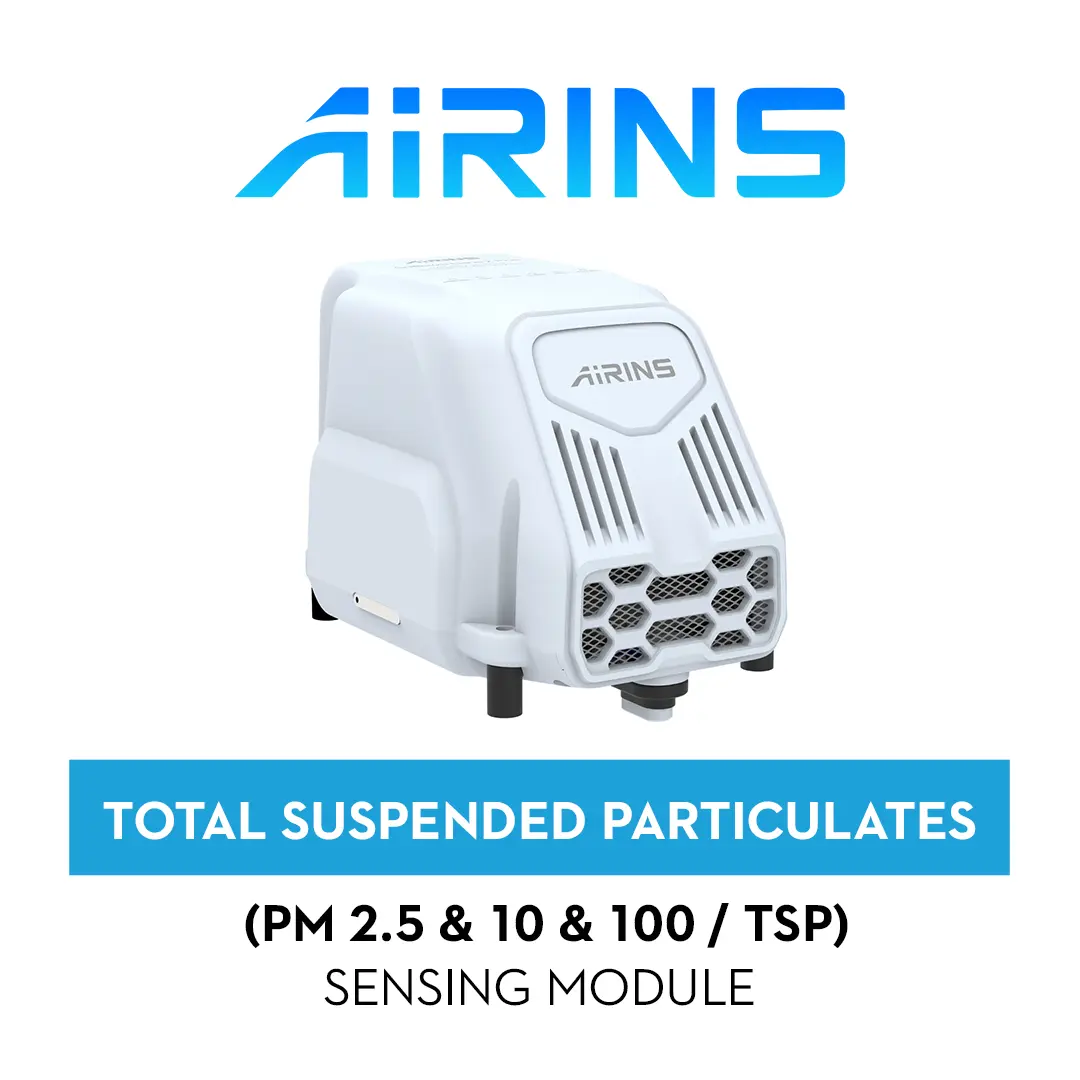
AIRINS Sniffer4D Total Suspended Particulates (PM 2.5 & 10 & 100 / TSP) Sensing Module

AIRINS Sniffer4D Total Suspended Particulates (PM 2.5 & 10 & 100 / TSP) Sensing Module

Regular price $863.00
Regular price Sale price $863.00
Sale Sold out
Shipping calculated at checkout.

SKU:S-AIN-S4D-N2P-PM-TSP

  • Light scattering sensor detects PM 2.5, PM 10, and PM 100
  • Fifty microgram detection limit captures coarse particulate matter accurately
  • Wide linear range covers dust heavy job sites and quarries
  • One second time resolution tracks rapid particulate concentration changes
  • Sub ten second response delivers timely readings during active flight
  • Twenty thousand hour service life supports extended long term deployment
  • Wide temperature range spans negative thirty to seventy degrees Celsius
  • Humidity tolerant design operates in up to ninety five percent RH
  • Full slot dedication extends particulate coverage up to 100 microns
View full details
  • Description
  • Specifications
  • In the Box
  • FAQ

Sniffer4D Total Suspended Particulates (TSP) Sensing Module: Cover Particulates Up to 100 Microns in One Flight

The Sniffer4D Total Suspended Particulates (PM 2.5, 10, and 100/TSP) Sensing Module occupies all five internal slots on a Sniffer4D Nano 2 Plus Base Unit, dedicating the entire platform to broad range particulate detection from fine dust through coarse suspended matter up to 100 microns in size. Its light scattering sensor tracks three particle bands at once, giving field teams a single reading set for dust heavy environments.

Because it claims every module slot, this configuration trades multi-gas flexibility for particulate coverage that extends well beyond the standard PM module's 10 micron ceiling. It suits demolition sites, quarries, agricultural operations, and construction zones where coarse particulate matter is the primary air quality concern, and where fine gas detection is not the mission priority.

Key Features and Benefits

  • Light scattering detection: senses PM 2.5, PM 10, and PM 100.
  • 50 ug/m3 detection limit: captures coarse particulate matter concentrations accurately.
  • 3000 ug/m3 linear range: covers dust heavy environments and job sites.
  • One second time resolution: tracks rapid changes in particulate concentration.
  • Under 10 second response: delivers timely readings during active flight.
  • 20000 hour service life: built for extended long term deployment.
  • Wide operating range: functions from -30 to 70 degrees Celsius.
  • Humidity tolerant design: operates up to 95% RH non-condensing conditions.
  • Full slot dedication: claims all five Base Unit slots for coverage.

The TSP Sensing Module exists to give programs a dedicated way to screen coarse airborne particulates that standard PM sensors are not built to measure. By covering particle sizes up to 100 microns in a single configuration, it fills a gap that finer particulate modules cannot reach.

DSLRPros stocks the TSP Sensing Module ready to install into your Sniffer4D Nano 2 Plus Base Unit, with fit confirmed before it leaves our facility. If you are unsure whether TSP or the standard PM module fits your monitoring program, our technicians can walk through the difference. Order the TSP Sensing Module from DSLRPros and cover coarse particulate detection in your next flight.

  • Detection principle: light scattering
  • Measures: PM 2.5 (0.3–2.5 µm), PM 10 (0.3–10 µm), PM 100/TSP (1–100 µm)
  • Particle counting effectiveness: 50% at 0.3 µm, 98% at ≥0.5 µm
  • Linear range: 30 to 3,000 µg/m³
  • Limit of detection: 50 µg/m³
  • Display resolution: 1 µg/m³
  • Time resolution: 1 second
  • Overall response time: ≤10 seconds
  • Estimated service life: ≥20,000 hours
  • Operating temperature: -30 to 70°C
  • Operating humidity: 0–95% RH (non-condensing)
  • On-chip proprietary humidity correction algorithm

1x AIRINS Sniffer4D Total Suspended Particulates (PM 2.5 & 10 & 100 / TSP) Sensing Module

What is the difference between this module and the standard PM Sensing Module?

The TSP module measures larger particle sizes, up to 100 microns, while the standard PM 1.0/2.5/10 module tops out at 10 microns. The TSP module also occupies all five of the Base Unit's internal slots as a standalone configuration, while the standard PM module uses just one slot and can be combined with other sensors. Choose TSP for dust heavy environments like construction or quarry sites, and the standard PM module when you need particulate data alongside other gas readings. DSLRPros can help you decide which fits your monitoring program.

Can this module be combined with other sensing modules in the same Base Unit?

No. The TSP Sensing Module occupies all five of the Base Unit's internal slots, so it cannot be installed alongside any other sensing module. This is different from most other Sniffer4D modules, which use a single slot and leave room for additional sensors. If your mission needs both TSP coverage and other gas readings, you would need a second Base Unit configured separately for that purpose.

What temperature and humidity range does this module handle?

The module is rated to operate from -30 to 70 degrees Celsius and up to 95 percent relative humidity, as long as conditions remain non-condensing. This wide range supports deployment across most outdoor field conditions, from cold weather job sites to humid construction zones. The on-chip humidity correction algorithm helps maintain data quality across that range. DSLRPros can advise on additional considerations for extreme site conditions.

Does this module require its own Base Unit to operate?

Yes. The TSP Sensing Module installs into a Sniffer4D Nano 2 Plus Base Unit, which supplies power, connectivity, data storage, and the physical mount to your drone. It is not a standalone flying sensor on its own. If you do not already own a Base Unit, DSLRPros can configure one with this module pre-installed and tested.

How quickly does the module respond to changing particulate levels?

The module has a time resolution of 1 second and an overall response time of 10 seconds or less, so readings update quickly as the aircraft moves through a survey area. This makes it suitable for mapping particulate concentration changes across a site in a single pass rather than requiring multiple slow flyovers. Combined with its wide detection range, this gives you a responsive dataset for dust heavy environments.