Skip to product information
1 of 1

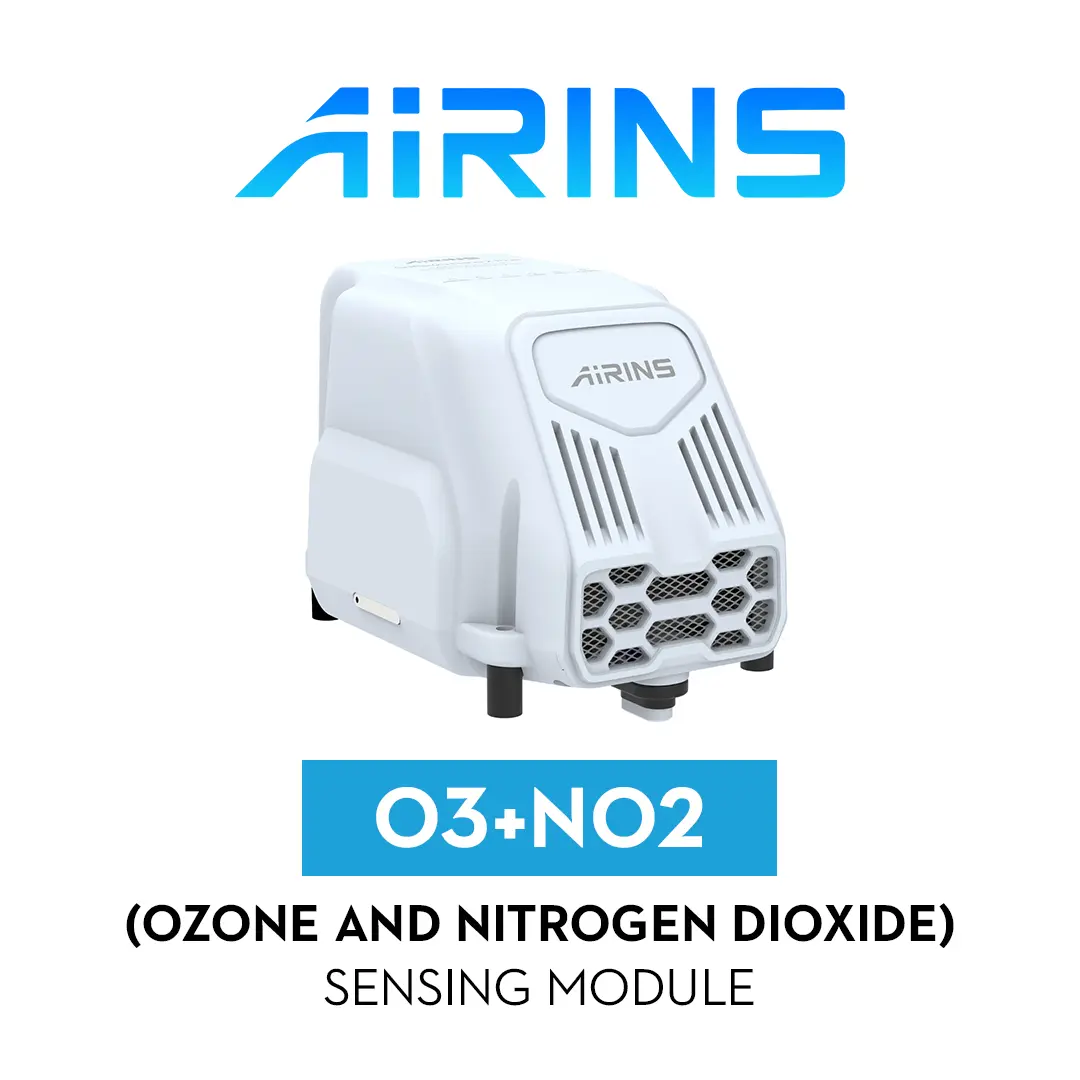
AIRINS Sniffer4D O3+NO2 Sensing Module

AIRINS Sniffer4D O3+NO2 Sensing Module

Regular price $1,643.00
Regular price Sale price $1,643.00
Sale Sold out
Shipping calculated at checkout.

SKU:S-AIN-S4D-N2P-O3NO2

  • Electrochemical sensor detects combined ozone and nitrogen dioxide oxidant levels
  • Ten part per billion limit catches low level oxidant concentrations early
  • Wide linear range covers trace levels through elevated oxidant events
  • Sub forty five second response delivers readings across low concentrations
  • Onboard humidity correction maintains accuracy across variable field conditions
  • One part per billion resolution captures fine oxidant concentration shifts
  • Twenty four month service life supports extended field deployment cycles
  • Single slot install adds oxidant sensing without claiming full array
  • Wide humidity tolerance operates reliably from fifteen to eighty five percent
View full details
  • Description
  • Specifications
  • In the Box
  • FAQ

Sniffer4D O3+NO2 Sensing Module: Track Photochemical Oxidant Levels in a Single Flight

The Sniffer4D O3+NO2 Sensing Module adds photochemical oxidant detection to a Sniffer4D Nano 2 Plus Base Unit, using electrochemical sensing to track the combined presence of ozone and nitrogen dioxide in a single slot. Field teams monitoring general air quality can add this module to any Base Unit build alongside other sensors.

Because the sensor reports O3 and NO2 as a combined oxidant value rather than two separate readings, operators typically pair it with a standalone NO2 module when individual ozone concentration needs to be isolated using the formula O3 equals the combined reading minus NO2. On its own, it suits general photochemical oxidant monitoring where a combined reading is sufficient.

Key Features and Benefits

  • Electrochemical sensing: detects combined ozone and nitrogen dioxide oxidant levels.
  • 10 ppb detection limit: catches low level photochemical oxidant concentrations early.
  • 11 ppm linear range: covers trace levels through elevated oxidant events.
  • Under 45 second response: delivers readings quickly across 0 to 1ppm.
  • Humidity correction: on-chip algorithm maintains accuracy across variable field conditions.
  • 1 ppb resolution: captures fine shifts in oxidant gas concentration.
  • 24 month service life: supports extended field deployment before replacement.
  • Single slot install: adds oxidant sensing without claiming the full array.
  • Wide humidity range: operates reliably from 15 to 85 percent RH.

The O3+NO2 Sensing Module exists to give environmental programs a way to track photochemical oxidant levels without adding a full standalone air quality station. Paired with a companion NO2 module when individual O3 data is required, it turns a single Base Unit slot into a flexible oxidant monitoring tool.

Choosing between a combined oxidant reading and full O3 and NO2 separation is easier with DSLRPros technicians on the line, since we can help you decide whether a companion NO2 module fits your monitoring goals. Order the O3+NO2 Sensing Module from DSLRPros and add photochemical oxidant tracking to your next flight.

  • Detection principle: electrochemistry
  • Linear range: 0 to 11 ppm
  • Limit of detection: 10 ppb
  • Repeatability: <4% FS
  • Overall response time (t90): <45 seconds (0-1 ppm)
  • Display resolution: 1 ppb
  • On-chip proprietary humidity correction algorithm
  • Warm-up time from cold start: β‰ˆ2 minutes (notably longer than the PM modules' <10 second warm-up)
  • Sensitivity drift: -20 to -40%/year (laboratory environment)
  • Zero drift: 0 to 20 ppb/year (laboratory environment)
  • Estimated service life: >24 months
  • Operating temperature: -30 to 40Β°C β€” note: the module may require zero-point readjustment due to changes in operating temperature or working environment
  • Operating humidity: 15 to 85% RH
  • Application: general environmental monitoring
  • Sensitive to both O3 and NO2, but unable to identify individual concentrations; Individual O3 concentration is calculated using: O3=(O3+NO2)-NO2.
  • 1x AIRINS Sniffer4D O3+NO2 Sensing Module
Does this module measure ozone and nitrogen dioxide separately?

No, not on its own. The O3+NO2 Sensing Module reports a single combined oxidant value and cannot distinguish how much of that reading comes from ozone versus nitrogen dioxide individually. To isolate the O3 concentration specifically, you need a separate standalone NO2 module flying alongside it, since individual O3 is calculated as the combined reading minus the NO2 module's reading. If your program only needs a general photochemical oxidant indicator, this module works well on its own.

How long does the module take to warm up before readings are accurate?

The module takes approximately 2 minutes to warm up from a cold start, which is longer than some of the other Sniffer4D sensing modules. Plan your pre-flight checklist accordingly so the sensor has stabilized before you begin data collection. DSLRPros can walk you through recommended pre-flight timing if you are setting up a standard operating procedure.

Does this sensor need recalibration over time?

The module's published specifications include a sensitivity drift of -20 to -40 percent per year and a zero drift of 0 to 20 ppb per year, both measured in laboratory conditions. AIRINS notes that the module may also require zero-point readjustment when operating temperature or environment changes significantly. We do not have a specific recalibration interval to share beyond these figures, so we would recommend contacting DSLRPros or AIRINS directly if you need a defined maintenance schedule for a long-running program.

What temperature and humidity range does this module support?

The module operates from -30 to 40 degrees Celsius and 15 to 85 percent relative humidity. This is a narrower range than some of the other Sniffer4D modules, so it is worth checking against your typical deployment conditions, especially in very hot or very dry environments. The on-chip humidity correction algorithm helps maintain data quality within that range.

Do I need a specific Base Unit or drone to use this module?

The module installs into any Sniffer4D Nano 2 Plus Base Unit, which connects natively to the DJI Matrice 4D and 4TD, with integration kits available separately for the Matrice 400, Matrice 4E and 4T, and Matrice 350 and 300. If you do not already own a Base Unit, DSLRPros can configure one with this module installed and tested before it ships.