






PIX4D Photogrammetry Software: Modular Desktop and Cloud Mapping Tools for Survey, Agriculture, and Emergency Response
PIX4D is a photogrammetry software platform that converts aerial and ground-based imagery into georeferenced maps, 3D models, and point clouds. Founded in 2011 and headquartered in Lausanne, Switzerland, PIX4D's approach is modular — instead of one general-purpose platform, each product is purpose-built for a specific application: high-accuracy survey and mapping, large-scale dataset processing, agriculture, rapid emergency mapping, cloud-based collaboration, or CAD-compatible survey deliverables. The six products DSLRPros stocks cover the full range of professional drone data workflows, and all are hardware-agnostic — they process imagery from DJI, Autel, Inspired Flight, Sony, and other platforms without proprietary restrictions.
DSLRPros carries PIX4D licenses in monthly, annual, and perpetual formats where available. Our team provides pre-purchase guidance on which product fits your workflow and assists with license selection before you purchase.
PIX4D Products at a Glance
| Product | What It Does Core Function | Where It Runs Desktop or Cloud | Who It's For Best Fit | Output What You Get |
|---|---|---|---|---|
| PIX4Dmapper | Survey-grade photogrammetry — 2D maps and 3D models from drone or aerial imagery | Desktop (Windows/Mac); offline capable | Surveyors, GIS professionals, engineers requiring accuracy-critical deliverables with GCP support | Orthomosaics, point clouds, DSM/DTM, 3D mesh; centimeter-level accuracy with GCPs |
| PIX4Dmatic | Large-scale and corridor mapping; combined LiDAR and imagery processing at volume | Desktop (Windows); offline capable | Large survey programs, corridor mapping (power lines, pipelines, roads), high-frequency repeat surveys | High-density point clouds, DSM/DTM, orthomosaics at scale; faster processing than Mapper for large datasets |
| PIX4Dcloud | Cloud-based photogrammetry, team collaboration, site progress documentation | Browser-based; no desktop software required | Construction, AEC, and site monitoring programs needing cloud-accessible outputs and team sharing | Orthomosaics, 3D models, volume measurements, annotations; accessible from any browser |
| PIX4Dfields | Multispectral and RGB processing for agricultural analysis | Desktop and mobile; field-optimized processing | Agronomists, farmers, and precision ag consultants using multispectral payloads | NDVI, NDRE, and other vegetation index maps; crop health analysis; zone management outputs |
| PIX4Dreact | Rapid 2D orthomosaic generation for incident command and disaster response | Desktop; optimized for speed over accuracy | First responders, public safety agencies, emergency management teams | 2D orthomosaics in minutes; fast situational awareness maps for field use |
| PIX4Dsurvey | Vector file extraction from point clouds for CAD and land survey workflows | Desktop; works with PIX4Dmapper and LiDAR outputs | Licensed surveyors and engineering firms delivering CAD-compatible survey products | Contour lines, breaklines, 3D polylines, and survey-standard vector files for AutoCAD, Civil 3D, Trimble |
Scroll horizontally to view all product details. Contact DSLRPros for license tier, pricing, and format guidance before purchasing.
What Each PIX4D Product Does
PIX4Dmapper is the core desktop photogrammetry platform for survey-grade 2D maps and 3D models. It processes imagery from drone, handheld, or aerial sources and supports ground control points (GCPs) for centimeter-level absolute accuracy. Processing runs entirely offline on a local workstation with no cloud dependency, making it suitable for programs where data cannot leave the processing environment. Outputs include georeferenced orthomosaics, dense point clouds, DSMs and DTMs, and 3D textured meshes compatible with GIS, CAD, and BIM platforms. PIX4Dmapper is the standard choice for cadastral survey, topographic mapping, infrastructure documentation, and any workflow where the final deliverable must meet survey-grade accuracy standards.
PIX4Dmatic is designed for programs that outgrow Mapper's practical dataset limits — large-area surveys, linear corridor mapping (power lines, pipelines, railways), and workflows combining LiDAR point clouds with photogrammetric imagery in a single processing environment. It processes substantially larger datasets faster than Mapper and handles the combined LiDAR and imagery workflows that infrastructure inspection and corridor mapping programs increasingly require. The correct choice when dataset scale, processing speed, or LiDAR-imagery fusion is a constraint rather than sensor compatibility or accuracy control.
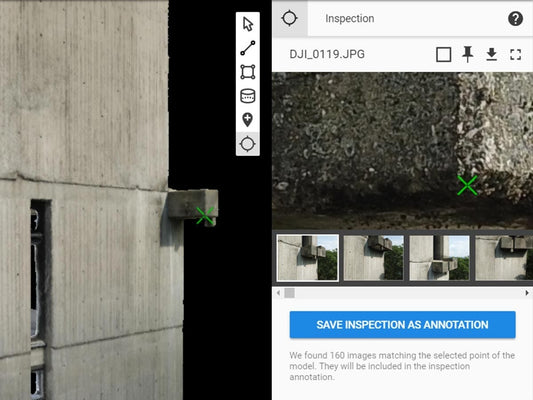
PIX4Dcloud is the browser-based version of PIX4D's photogrammetry engine — no local workstation required. Imagery uploads to PIX4D's cloud infrastructure for processing and the outputs are accessible from any browser for team annotation, volume measurement, and progress documentation. PIX4Dcloud is the correct choice for construction and site monitoring programs where multiple team members need to access, annotate, and share processed outputs without managing desktop software installations. It does not provide the GCP-based accuracy control or offline processing of PIX4Dmapper.
PIX4Dfields processes multispectral and RGB imagery specifically for agricultural analysis. It generates NDVI, NDRE, and other vegetation index maps from sensors including MicaSense RedEdge-P, MicaSense Altum-PT, Sentera 6X multispectral, and DJI Zenmuse P1 (RGB band). Processing is optimized for speed in field or office conditions rather than the full photogrammetric accuracy of PIX4Dmapper — the output is agronomic insight (crop stress zones, irrigation anomalies, variable rate application prescription maps) rather than survey-grade geospatial deliverables. Compatible with precision agriculture decision platforms and variable rate application equipment.
PIX4Dreact generates 2D orthomosaic maps from drone imagery in minutes rather than the hours that full photogrammetry processing requires. It is the tool for incident command, search and rescue coordination, disaster damage assessment, and any scenario where a usable situational awareness map in the field within minutes of landing matters more than photogrammetric precision. First responders and emergency management teams use PIX4Dreact alongside standard photogrammetry software — it handles time-critical mapping during an active incident while PIX4Dmapper handles the post-event documentation analysis.
PIX4Dsurvey bridges photogrammetry and CAD by extracting vector survey data — contour lines, breaklines, 3D polylines, and feature points — from PIX4Dmapper point clouds or LiDAR datasets. It was developed with input from licensed surveyors to produce outputs that meet the vector file standards required for AutoCAD, Civil 3D, Trimble, and other engineering and cadastral survey platforms. If your deliverable is a georeferenced orthomosaic or 3D model, PIX4Dmapper alone is sufficient. If your deliverable is a CAD-compatible vector survey file for engineering, permitting, or cadastral submission, PIX4Dsurvey is the additional processing step that produces it.
Which PIX4D Product Do You Need?
- Survey-grade maps and 3D models with GCP accuracy control: PIX4Dmapper — offline desktop processing, centimeter-level accuracy, broadest sensor support
- Large-area or corridor surveys at scale, or combined LiDAR and imagery: PIX4Dmatic — faster at volume than Mapper, handles LiDAR-imagery fusion workflows
- Cloud access and team collaboration without desktop software: PIX4Dcloud — browser-based, multi-user annotation, volume measurement and progress tracking
- Precision agriculture and multispectral NDVI analysis: PIX4Dfields — fast field-optimized processing for crop health maps and agronomic indices
- Emergency response and rapid incident mapping: PIX4Dreact — orthomosaics in minutes, not hours; built for first responder workflows
- CAD-compatible vector deliverables from point clouds: PIX4Dsurvey — contour lines, breaklines, and 3D polylines for engineering and cadastral survey submission
- Using DJI Terra and want to evaluate PIX4D: PIX4Dmapper provides broader sensor support and produces survey-grade results; DJI Terra is DJI-native and does not advertise survey-grade accuracy — the comparison guide linked above covers the full tradeoffs
Where PIX4D Gets Used
- Land survey and cadastral mapping: PIX4Dmapper with GCPs produces the survey-grade orthomosaics and point clouds that support legal boundary determination, topographic surveys, and regulatory submission
- Construction progress monitoring: PIX4Dcloud enables site managers to track earthworks, verify specification compliance, and share annotated progress maps with stakeholders without requiring local software installation
- Mining stockpile and pit management: PIX4Dmapper and PIX4Dmatic generate the volumetric calculations and pit progression data that replace manual measurement workflows in active mining operations
- Power line and pipeline corridor inspection: PIX4Dmatic handles the long linear datasets that corridor mapping produces, combining LiDAR and imagery into corridor deliverables that general mapping platforms handle poorly at scale
- Precision agriculture: PIX4Dfields converts multispectral flights into zone management maps, variable rate application prescriptions, and crop stress documentation compatible with farm management platforms
- Emergency response and disaster assessment: PIX4Dreact produces actionable maps within minutes of landing, enabling incident commanders to make resource allocation decisions while the event is still active
- Engineering and infrastructure survey: PIX4Dsurvey extracts the vector deliverables — contour lines, breaklines, feature points — that engineering firms require for project design, permitting, and construction document preparation
- Environmental monitoring: PIX4Dmapper's repeat-flight workflows produce temporal datasets for tracking landscape change, erosion, habitat boundaries, and vegetation structure across seasons and years
Frequently Asked Questions
What is the difference between PIX4Dmapper and PIX4Dmatic?
Both are desktop photogrammetry platforms for professional mapping, but they serve different scales and workflows. PIX4Dmapper is the standard platform for survey-grade accuracy — it supports GCP integration for centimeter-level absolute precision, offers detailed processing control, and handles most project-scale datasets. PIX4Dmatic is built for larger volumes — faster processing at scale, better handling of corridor datasets, and native support for combined LiDAR and imagery workflows. For most survey and mapping programs at standard project scale, start with PIX4Dmapper. For programs running large-area surveys, long linear corridors, or high-frequency repeat missions where processing speed and dataset volume are constraints, PIX4Dmatic is the correct step up.
Does PIX4D work with DJI drones?
Yes. PIX4D is hardware-agnostic — it processes imagery from DJI enterprise aircraft including the Matrice 4E, Matrice 4D, Matrice 350 RTK, Matrice 400, and Phantom 4 RTK, as well as Autel, Inspired Flight, Sony ILX-LR1, and other platforms. PIX4Dfields is compatible with multispectral sensors including the DJI Zenmuse P1 (RGB band), MicaSense RedEdge-P, MicaSense Altum-PT, and Sentera 6X. PIX4D is not tied to a specific drone manufacturer, which is a meaningful distinction from DJI Terra, which processes DJI hardware natively but has limited support for sensors from other manufacturers.
What is PIX4Dsurvey and do I need it in addition to PIX4Dmapper?
PIX4Dsurvey extracts vector survey data — contour lines, breaklines, 3D polylines, and feature points — from photogrammetry point clouds and LiDAR datasets for use in CAD environments. If your deliverable is a raster orthomosaic, DEM, or 3D model, PIX4Dmapper alone produces that output. If your deliverable is a CAD-compatible vector file for engineering, permitting, or cadastral survey submission, PIX4Dsurvey is the additional processing step required to produce it. Licensed surveyors and civil engineering firms delivering survey files to AutoCAD, Civil 3D, or Trimble environments typically need both.
How does PIX4Dfields differ from PIX4Dmapper for agriculture?
PIX4Dfields is purpose-built for agricultural multispectral analysis — it processes imagery faster in a field-optimized workflow and generates the specific outputs that precision agriculture decisions require: NDVI and NDRE vegetation index maps, zone management layers, and crop stress documentation compatible with variable rate application equipment and farm management platforms. PIX4Dmapper can also process multispectral imagery and produce georeferenced outputs, but it is a general-purpose photogrammetry platform optimized for accuracy rather than agronomic outputs. For programs where the primary deliverable is a crop health map or prescription zone file, PIX4Dfields is the appropriate tool. For programs that also need survey-grade orthomosaics from the same imagery — for example, drainage mapping or field boundary determination — PIX4Dmapper handles the complementary survey processing.
Can I use PIX4Dreact alongside my regular mapping software?
Yes, and that is how most programs use it. PIX4Dreact is optimized for speed over accuracy — it generates a usable 2D orthomosaic in minutes that enables rapid field decision-making during an active incident. It is not a replacement for PIX4Dmapper's survey-grade processing. Emergency management programs typically maintain both: PIX4Dreact for time-critical situational awareness during an active event, and PIX4Dmapper or PIX4Dcloud for the post-event documentation and damage assessment analysis that requires full photogrammetric accuracy.
Shop PIX4D Software at DSLRPros
PIX4D's modular structure means most programs use more than one product — a surveying firm might run PIX4Dmapper for standard projects and PIX4Dsurvey for clients requiring CAD deliverables; a public safety agency might pair PIX4Dreact for active incidents with PIX4Dmapper for after-action documentation. DSLRPros carries all six PIX4D products in monthly, annual, and perpetual licensing formats where available, and our team helps match the right combination to your workflow before you purchase.
Contact DSLRPros to discuss which PIX4D product or combination fits your program, or to request a quote on multi-seat enterprise licensing.


