

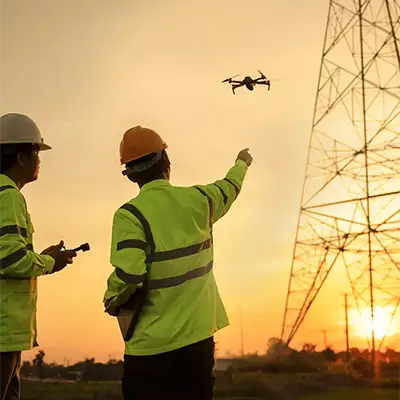


Comprehensive Guide: DJI Matrice 4 Thermal vs. DJI Matrice 4TD
When it comes to enterprise drone operations, deploying the right aircraft for your specific mission parameters is the difference between a successful operation and a grounded fleet. DJI’s Matrice 4 Series has introduced a new tier of intelligent, multi-sensor capabilities for public safety, inspection, and infrastructure management. However, choosing between the different configurations requires a deep understanding of your operational needs.
Two of the most capable models in this lineup are the DJI Matrice 4 Thermal (M4T) and the DJI Matrice 4TD (M4TD). While they share an incredible optical and thermal imaging core, they are engineered with distinctly different airframes, environmental tolerances, and deployment methods.
Quick Decision Summary: Which One Should You Choose?
- Choose M4T for price, manual flight, rapid deployment.
- Choose M4TD for all-weather operation, rugged infrastructure inspection. Ability to add the dock 3 later on
- Choose M4TD + Dock 3 for autonomous, remote, 24/7 standby deployment.
At-a-Glance Comparison
For teams evaluating differences quickly, the chart below highlights the core operational distinctions:
| Category | M4T | M4TD |
|---|---|---|
| Airframe | Foldable | Fixed-arm |
| IP Rating | Unrated | IP55 |
| Max Flight Time | 49 min | 54 min |
| Upward Gimbal Tilt | ~35° | 80° |
| Dock 3 Compatible | No | Yes |
While both aircraft share the same thermal and optical core, the differences above define their deployment roles — mobile rapid response versus infrastructure-ready autonomy.
DJI Matrice 4 Thermal (M4T): The Portable, Rapid-Deployment Powerhouse
The DJI Matrice 4T is designed from the ground up for teams that need to move fast. It is the ultimate "grab-and-go" solution for mobile units, tactical teams, and search and rescue (SAR) operators.

Key Informational Highlights:
- Ultra-Portable Airframe: Weighing just 1,219 grams, the M4T features foldable arms, allowing it to easily fit into a backpack or a small hard case. It can be unpacked, powered on, and airborne in just 15 seconds.
- Six-Sensor Payload: Despite its compact size, the M4T features an unprecedented payload array. It includes a 48 MP wide camera, a 48 MP medium telephoto camera, a 48 MP telephoto camera (with 112x hybrid zoom), an uncooled VOx thermal sensor (640 × 512 base resolution with a 1280 × 1024 Super Resolution mode), a Laser Rangefinder effective up to 1,800m, and a Near-Infrared (NIR) Auxiliary Light for enhanced night operations.
- Flight Performance: It delivers an impressive maximum flight time of up to 49 minutes and can withstand wind speeds up to 12 m/s, making it highly reliable for manual, line-of-sight, and extended operations.
Best For: Search & rescue, first responders, law enforcement, and mobile inspection crews who prioritize portability, quick deployment, and hands-on manual piloting.
DJI Matrice 4TD: The Automated, All-Weather Workhorse
The DJI Matrice 4TD takes the imaging power of the M4T and houses it inside a rugged, fixed-arm airframe designed for permanent deployment and extreme weather conditions. While optimized for automated "Drone in a Box" operations via the DJI Dock 3, the M4TD is increasingly popular as a standalone unit paired with the DJI RC Plus 2 Enterprise controller.

Key Informational Highlights:
- Extreme Durability: The M4TD features a fixed-arm design (non-foldable) and boasts an IP55 rating, protecting it against heavy rain, fog, and dust. It also operates in a wider temperature range, from a freezing -20°C up to blistering 50°C.
- What IP55 Means Operationally: IP55 protection safeguards against heavy dust ingress and sustained low-pressure water jets. This allows safe deployment in rain, fog, and high-particulate industrial environments where unrated aircraft must stand down.
- Advanced Obstacle Sensing: Unlike the M4T's standard vision/infrared system, the M4TD incorporates an advanced Obstacle Sensing Module that combines rotating LiDAR and millimeter-wave radar. This allows it to detect obstacles as thin as 12mm (like powerlines) while flying at speeds up to 15 m/s.
- Specialized Inspection Capabilities: The M4TD's gimbal unlocks an 80-degree upward tilt. This is critical for infrastructure professionals who need to inspect the undersides of bridges, overhangs, and complex overhead structures without repositioning the aircraft. It also includes an IR-Cut Filter for true black-and-white night vision.
- Extended Endurance: The heavier airframe (1,850 g) accommodates a high-capacity battery system, pushing the maximum flight time to 54 minutes. Furthermore, its batteries support fast charging from 15% to 90% in under 30 minutes.
Best For: Automated Dock 3 networks, Fire & Police departments, heavy industrial inspections, power grid monitoring, and any standalone manual operation that requires flying in rain, snow, or high-dust environments. Also ideal for use cases that require overhead inspections.
When DJI Dock 3 Changes the Equation
The difference between the M4T and M4TD is not just durability — it’s deployment architecture. The M4TD is engineered to support autonomous launch-and-land cycles via DJI Dock 3, enabling persistent coverage without a pilot physically present at the launch site.

For agencies evaluating remote perimeter monitoring, critical infrastructure protection, or Drone-as-First-Responder (DFR) expansion, this distinction becomes operational — not just technical. The ability to stage aircraft at fixed locations and deploy on demand changes staffing models, response times, and coverage strategy.
Below is a practical deployment alignment overview:
| Operational Goal | Recommended Platform |
|---|---|
| Vehicle launch | M4T |
| Overhead Inspection | M4TD |
| Fixed perimeter | M4TD + Dock 3 |
| Heavy precipitation | M4TD |
In short, if your deployment model includes fixed-site coverage, weather resilience, or autonomous scaling, the M4TD moves from performance upgrade to infrastructure platform.
Operational Workflow Examples
Specifications explain capability. Workflows explain impact.

Fire Department – Structure Fire Overhaul
- Deploy thermal scan to detect residual hotspots.
- Use laser rangefinder to confirm safe standoff distances.
- Capture UHR thermal stills for documentation and reporting.
- M4TD advantage: rain-resistant monitoring + upward tilt roof inspection.
Power Utility Inspection
- Conduct line scan for heat anomalies.
- Use upward tilt (M4TD) to inspect the underside of conductors and crossarms.
- Document anomalies with zoom + thermal overlay.
- Faster charging on M4TD reduces downtime between inspection cycles.
Police DFR Program
- M4T: Manual vehicle deployment, officer-operated.
- M4TD + Dock 3: Remote dispatch from fixed site.
- Reduced on-site pilot staffing.
- Faster response window during standby operations.
These workflows illustrate how airframe design and autonomy integration affect mission efficiency — not just specs.
Specifications Comparison Chart
Both the M4T and M4TD share the same advanced imaging core, but they are built around different deployment priorities. The chart below provides a direct, side-by-side comparison of technical specifications and operational implications to help teams evaluate performance, durability, and long-term deployment fit.

This comparison highlights not just feature differences, but how those differences translate into real-world operational capability.
| Feature | DJI Matrice 4 Thermal (M4T) | DJI Matrice 4TD |
|---|---|---|
| Price | $7,999 | $9,999 |
| Primary Deployment | Manual piloting, rapid deployment | Automated docking, standalone all-weather |
| Airframe Design | Foldable arms | Fixed-arm |
| Weight | 1,219 g | 1,850 g |
| Ingress Protection | Basic weather resistance (Unrated) | IP55 (High Dust & Water Resistance) |
| Operating Temperature | -10°C to 40°C | -20°C to 50°C |
| Max Flight Time | Up to 49 minutes | Up to 54 minutes |
| Visual Cameras | 48MP Med. Tele + 48MP Tele (112x Hybrid Zoom) | 48MP Med. Tele + 48MP Tele (112x Hybrid Zoom) |
| Thermal Sensor | 640 × 512 (1280 × 1024 UHR capable) | 640 × 512 (1280 × 1024 UHR capable) |
| Night Vision Enhancements | NIR Auxiliary Light, Night Scene Mode | NIR Aux Light, Night Scene Mode, IR-Cut Filter |
| Laser Rangefinder | Up to 1,800 m | Up to 1,800 m |
| Gimbal Upward Tilt | Standard range (approx. 35°) | Up to 80° |
| Obstacle Sensing | Omnidirectional vision + 3D infrared | LiDAR + Radar (detects 12mm wires) |
| Fast Charging (15–90%) | ~50 minutes | ~28 minutes |
| Controller Compatibility | DJI RC Plus 2 | DJI RC Plus 2 / DJI Dock 3 |
| Operational Use Case (Fire Overhaul) | Rapid repositioning | Rain-resistant monitoring + upward tilt roof inspection |
| Operational Use Case (Power Utility Inspection) | Portable site visits | Underside inspection without repositioning |
| Operational Use Case (Police DFR) | Patrol vehicle deployment | Remote dispatch and staffing reduction (M4TD + Dock 3) |
While both aircraft deliver identical thermal and optical imaging performance, the differences in airframe durability, sensing systems, charging speed, and Dock 3 compatibility define their operational roles. The M4T prioritizes mobility and rapid response, while the M4TD is built for sustained deployment, harsh environments, and autonomous integration.
12-Month Ownership Considerations
Choosing between the M4T and M4TD should extend beyond initial specifications and purchase price. Over a 12-month operational cycle, differences in environmental resilience, deployment architecture, and charging efficiency directly influence uptime, staffing allocation, and mission continuity.
For agencies operating in demanding environments or planning program expansion, these factors become measurable operational costs — not theoretical advantages.
| Factor | M4T | M4TD |
|---|---|---|
| Weather Downtime | Higher | Lower |
| Autonomy Scaling | Limited | Strong |
| Battery Turnaround | Slower | Faster |
Example of a 12-Month Operational Scenario
Consider an agency operating four days per week in mixed weather conditions:
- The M4T may be grounded during sustained rain events due to lack of IP rating.
- The M4TD continues operating under IP55 protection.
- Faster 15–90% charging (~28 minutes) reduces turnaround time between sorties.
- Dock 3 integration enables remote standby without requiring constant on-site staffing.
Over a 12-month cycle, these differences can reduce weather-related downtime and improve coverage consistency, particularly for agencies operating fixed-site or DFR programs.
Frequently Asked Questions (FAQ)
1. Can I fly the Matrice 4TD manually without the DJI Dock 3?
Yes. While the M4TD is the flagship drone for the DJI Dock 3 system, it functions perfectly as a standalone, manually piloted aircraft when paired with the DJI RC Plus 2 Enterprise controller. Many enterprise teams purchase it purely for its IP55 weather rating and 80-degree gimbal tilt.
2. Are the batteries interchangeable between the M4T and M4TD?
No. Because the M4TD has a fixed-arm, heavier airframe designed for longer endurance and dock integration, it uses a different battery system with different capacities and energy ratings than the highly portable M4T.
3. Which drone is better for flying in the rain or snow?
The Matrice 4TD is the clear winner for harsh weather. It carries an IP55 ingress protection rating and features low-noise, anti-ice propellers. The M4T does not carry an official IP rating and should not be flown in heavy precipitation.
4. Do both models feature the same thermal camera?
Yes. Both the M4T and M4TD utilize the same highly capable uncooled VOx thermal sensor. They both offer a base resolution of 640 × 512 at 30 Hz, and both support the Ultra-High-Resolution (UHR) mode that digitally enhances thermal images to 1280 × 1024 for unparalleled clarity.
5. How does obstacle avoidance differ between the two models?
The M4T relies on an omnidirectional binocular vision system supplemented by a 3D infrared sensor. The M4TD upgrades this significantly with an Obstacle Sensing Module that combines rotating LiDAR and millimeter-wave radar, allowing it to navigate complex environments in total darkness and detect thin hazards like 12mm power distribution lines.
6. Is the Matrice 4TD just a weatherproof version of the M4T?
No. While both share the same imaging core, the M4TD is not simply a weatherproof M4T. It adds a fixed-arm industrial airframe, IP55 protection, LiDAR + radar sensing, faster charging, and DJI Dock 3 compatibility — making it built for sustained and autonomous deployment, not just harsher weather.
7. Can the M4TD be vehicle-mounted?
Yes. While the M4TD is optimized for DJI Dock 3 autonomous deployment, it can also be manually operated and staged from vehicles using the DJI RC Plus 2 Enterprise controller. Agencies often deploy it from response vehicles when weather resilience and upward gimbal tilt are mission priorities.
8. Does IP55 mean waterproof?
No. IP55 does not mean fully waterproof or submersible. It indicates protection against dust ingress and sustained low-pressure water jets, allowing safe operation in rain, fog, and harsh environments — but not immersion in water.
9. Which drone is better for 24/7 standby?
The Matrice 4TD is better suited for 24/7 standby operations, especially when paired with DJI Dock 3. Its rugged airframe, IP55 rating, faster battery charging, and autonomous integration support continuous readiness with reduced manual intervention.
10. Is upward tilt available on M4T?
No. The M4T does not support the 80-degree upward gimbal tilt found on the M4TD. The upward tilt capability on the M4TD enables underside inspection of bridges, overhangs, and infrastructure without repositioning the aircraft, which is a key advantage for industrial and utility workflows.
U.S. Procurement and Program Planning Considerations
For U.S.-based agencies and enterprise teams, aircraft selection increasingly intersects with procurement scrutiny and long-term sustainment planning.
When evaluating M4T vs M4TD, consider:
- Deployment model documentation (manual vs autonomous)
- Sustainment strategy (battery lifecycle, spares, charging infrastructure)
- Training plan for pilots or remote operators
- Infrastructure investment (Dock 3 staging sites)
- Weather resilience requirements tied to mission continuity
Agencies planning multi-year deployment or autonomous expansion should align aircraft selection with documented operational requirements — not just feature comparison.
Selecting the right platform early can reduce mid-cycle upgrades and procurement friction later.
Final Recommendation
The M4T is a rapid-response aircraft built for mobility and manual deployment.
The M4TD is an infrastructure-ready platform designed for weather resilience, advanced sensing, and autonomous integration.
The right decision depends on how your team deploys — not just what you fly.
Speak With a DSLRPros Specialist
Selecting the right platform impacts staffing, uptime, and long-term scalability. If you’re evaluating deployment models, Dock integration, or agency-specific requirements, our team can help you map the right configuration to your operational goals.
Contact DSLRPros to discuss mission fit, procurement options, and deployment strategy tailored to your organization.


