

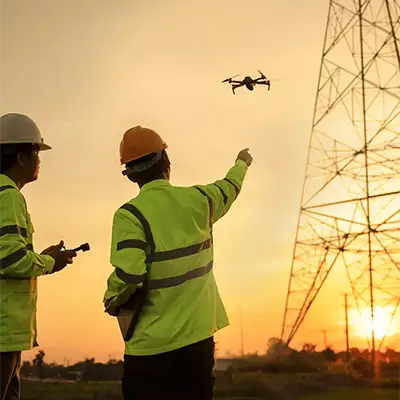


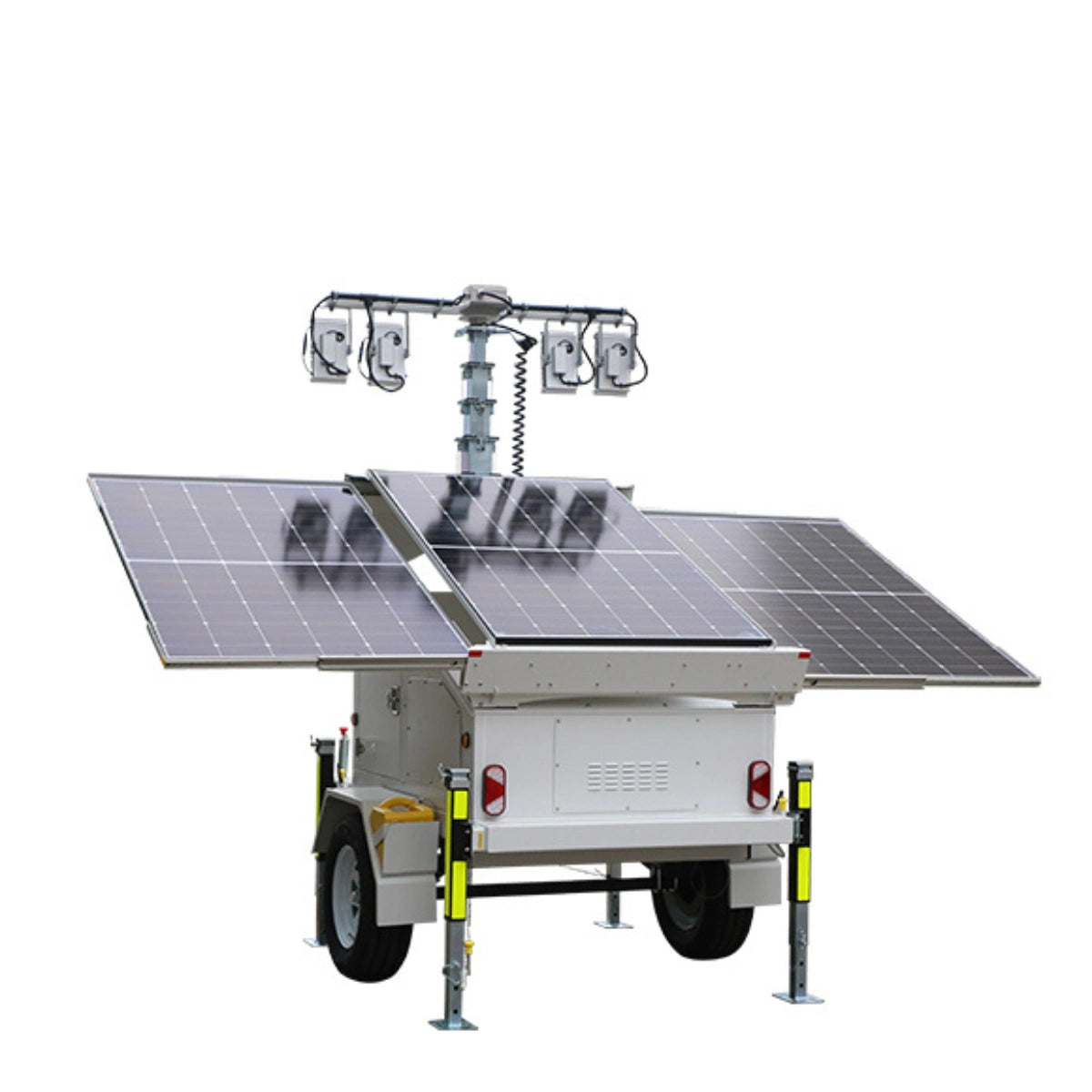


Solar Security Trailers and Drone Surveillance Systems for 24/7 Site Protection
Sites need constant protection. Theft, vandalism, trespass, and safety incidents continue to rise across construction, utilities, transportation, and public safety operations. A solar security trailer handles part of the job, but fixed cameras alone cannot cover large or changing environments. A drone security system fills the gaps with fast response, thermal visibility, wide-area coverage, and real-time intelligence.
Used together, they create a full perimeter security system that stays active day and night, on or off the grid.
This guide explains how solar-powered surveillance trailers and professional drones work together, where each system falls short, and how hybrid deployments give teams the strongest coverage. Everything here focuses on field use: stable power, consistent uptime, camera performance, night operations, public safety workflows, and site protection during high-risk periods.
What is the best way to secure a large site with solar power and drones?
Use a hybrid system. A solar security trailer provides 24/7 fixed coverage with cameras, lights, and networking. A drone surveillance system adds mobile response, thermal and zoom detail, and autonomous patrols. The trailer watches the site. The drone responds, investigates, and closes blind spots.
What You Need to Know
A solar security trailer:
- Provides 24/7 fixed coverage
- Uses solar power and a battery bank
- Supports PTZ, thermal, and floodlight systems
- Works anywhere without grid power
A drone surveillance system:
- Covers large areas fast
- Tracks subjects with thermal and zoom sensors
- Responds to alerts from trailers or sensors
- Works with DJI Dock 3 for autonomous patrols
The most reliable setup uses both.
The trailer watches the site.
The drone responds, investigates, and captures detail the trailer cannot see.
What Solar Security Trailers Are and Why They Matter
A solar security trailer is a mobile, self-powered surveillance unit built for remote and high-risk sites. It uses solar panels, batteries, cameras, and communication hardware to provide 24/7 monitoring without depending on grid power. This makes it useful for construction, utilities, transportation, public safety, disaster response, and temporary events.
For organizations evaluating different levels of mobile site protection, the DSLRPros ArgusLine Mobile Security Series offers options ranging from fixed-camera surveillance to AI-assisted detection and autonomous aerial response.
These trailers work as fixed observation points. They stay on-site, record activity, and send alerts when something changes.
Drones add the “response” layer. Trailers detect motion or unusual behavior. Drones investigate, verify, and record detail that fixed cameras miss. This combination is why many organizations now use both.
What a Solar Surveillance Trailer Includes
-
Solar power system
Provides continuous energy for cameras, lights, and network equipment. -
Battery bank
Keeps the unit running during night, storms, or low-sunlight days. -
Camera mast
Often includes PTZ, thermal, and wide-area lenses for different monitoring needs. -
LTE or mesh network hub
Sends data back to command centers or mobile devices. -
Local recording
Stores footage even when network signals are unstable. -
Floodlights or light towers
Improves visibility and night monitoring. -
Alarm and deterrent options
Sirens or speakers for on-site warnings.
Why Solar Security Trailers Matter
- They work anywhere: Solar power and onboard batteries allow full-time operation on remote sites.
- They run 24/7 without staff: Continuous monitoring is possible without additional manpower.
- They support public safety and industrial operations: Useful for crime prevention, equipment protection, facility monitoring, and incident documentation.
- They respond well to long deployments: Trailers stay active for months with proper maintenance.
- They provide predictable surveillance: Fixed cameras deliver consistent angles and constant coverage.
A solar powered security trailer covers what is in front of it. A drone covers everything else. That is why pairing the two creates stronger protection than relying on trailers alone.
Where Traditional Solar Trailers Fall Short
Solar security trailers work well for fixed monitoring, but they have limits every operator eventually sees. They watch the same direction. They do not move. They cannot chase people, vehicles, or drones. And when a site changes or expands, the trailer stays in place unless a crew relocates it.
This creates blind spots that matter on large jobsites, solar farms, substations, and public safety deployments.
A solar surveillance trailer plays an important role, but it does not provide full perimeter control by itself.
What are the main limitations of a solar security trailer?
- Fixed camera coverage with blind spots behind structures and equipment
- No ability to pursue or track moving subjects
- Manual repositioning required when the site changes
- Reduced uptime during poor weather or low-sun cycles
- No real-time mobile investigation without a drone
Fixed Coverage Only
A trailer sees what the mast camera can reach. If the threat occurs behind equipment, structures, containers, or vehicles, the trailer may not detect it. Operators often add more trailers just to cover simple blind zones.
Slow or No Response Capability
A trailer cannot follow suspects. It cannot move toward an alert or close the distance for detail. It only observes. For large sites or high-risk environments, passive observation is not enough.
Limited Detail at Long Distance
PTZ and thermal cameras help, but they still have practical limits. Image clarity drops at long ranges. Thermal signatures lose definition. If the subject moves behind terrain or equipment, the camera loses the line of sight.
Coverage Loss During Site Changes
Construction sites, solar farms, and utility areas shift often. Trailers must be repositioned manually, which takes time and requires crew availability. This leads to periods where parts of the site remain unmonitored.
Dependence on Weather and Lighting Conditions
Solar power works well, but:
- Heavy storms reduce solar input
- Dust and mud affect panel efficiency
- Night demands more battery draw
- Flooded or uneven terrain limits where trailers can be placed
These conditions reduce uptime or require additional maintenance.
No Real-Time Tracking or Investigation
A solar powered security trailer does not:
- Validate alarms
- Track movement across the site
- Provide close-up identification on demand
- Cover large perimeters quickly
This is where a drone surveillance system fills the gaps. A drone moves, reacts, investigates, and records detail that fixed equipment cannot reach.
How Drones Fill These Gaps
A drone surveillance system solves the limitations of a solar security trailer. Drones cover ground that fixed cameras cannot. They move fast, gather detail, and provide perspective from any angle. When a trailer detects motion, the drone verifies the alert. When something happens outside the trailer’s view, the drone finds it.
This creates a complete security workflow: detect, respond, investigate, and document.
A perimeter security drone becomes the mobile element that fixed systems lack. It closes blind spots, follows subjects, and gives teams real-time intelligence.
How Drones Complement Solar Trailers
- Trailers provide constant, fixed monitoring and deterrence.
- Drones provide mobile response, tracking, and identification.
- Trailers detect motion or alarms.
- Drones verify incidents, capture detail, and document what happened.
The strongest security setups use both systems together instead of choosing one over the other.
Rapid Response and Real-Time Investigation
Drones move quickly across large sites. When a solar surveillance trailer triggers an alert, a drone can reach the location in seconds. Operators get immediate visual confirmation with thermal, RGB, or zoom sensors. This reduces false alarms and improves decision-making.
Wide-Area Coverage
A single drone can watch an entire construction site, solar field, or substation in minutes. Trailers cannot match this mobility. A drone covers thousands of feet of perimeter or inspects multiple zones without relocating equipment. For large facilities, this is the only practical way to maintain full coverage.
Close-Range Identification
PTZ cameras struggle with clarity beyond a certain distance. A drone can fly closer, adjust angle, and capture identification-level detail. Zoom sensors on platforms like the DJI Matrice 4T make this even easier. This matters when verifying intruders, vehicles, or potential hazards.
Thermal Tracking and Night Visibility
Professional drone security systems use thermal sensors to detect heat signatures. This gives operators strong visibility during low-light or night conditions. Thermal cameras also help track movement through vegetation, behind equipment, or across uneven terrain. Solar-powered security trailers may include thermal PTZ, but drones bring mobility and angle flexibility.
Adaptive Coverage for Changing Sites
Drones adjust to shifting conditions. Construction zones grow. Solar farms expand. Equipment gets moved. A drone adjusts instantly without needing relocation or hardware changes. This makes drones effective for dynamic environments where every week looks different.
Supports Autonomous Operation
Many professional platforms support automated patrols.
DJI Dock 3 and similar systems allow a drone to:
- Launch autonomously
- Fly pre-planned routes
- Respond to alerts
- Capture footage
- Return and recharge
- Maintain constant readiness
This level of automation is not possible with trailers.
Completes the Security Stack
A solar trailer detects.
A drone investigates.
Together, they create a complete security system that covers ground, air, and perimeter.
Relying on one or the other leaves gaps. Using both creates continuous coverage with fast response.

How Solar Security Trailers Power Drone Operations
A solar security trailer does more than power cameras. It can support drones directly by supplying energy, communications, lighting, and infrastructure for autonomous operations. This turns the trailer into a mobile field base for drone flights.
For many teams, this is the most practical way to run a drone security system in remote or off-grid environments.
Solar trailers help drones stay active longer, respond faster, and operate safely at night. This makes trailers essential for teams that need uninterrupted coverage.
Can a Solar Trailer Power a Drone System?
Yes. A solar security trailer can power a drone security system by supplying off-grid energy for controllers, tablets, mesh radios, antennas, Dock 3 hardware, lighting, and network gear. It effectively functions as a mobile base station for drones in remote or power-limited environments.
Off-Grid Power for Drone Systems
Drones need consistent power for flight control, charging, and data links.
A solar powered security trailer provides reliable energy for:
- Drone controller charging
- Tablets, mission laptops, and RC Pros
- Command radios and mesh nodes
- Wi-Fi or LTE hotspots
- Landing zone floodlights
- Portable ground antennas
This removes the need for generators or temporary wiring.
It keeps the drone system ready even when the site has no permanent power.
Supporting DJI Dock 3 and Autonomous Drone Operations
DJI Dock 3 requires stable power, connectivity, and a secure mounting location.
A solar surveillance trailer can support all three, making it a strong partner for autonomous drone deployments.
A trailer can supply:
- Continuous power for Dock 3 climate control and electronics
- Battery backup during low-sun periods
- Elevated mast positions for antennas or repeater nodes
- A mobile platform to relocate Dock 3 as the site expands
- Space for routers, UPS systems, and ruggedized networking gear
This combination allows teams to launch autonomous flights almost anywhere.
It also supports Drone as First Responder (DFR) operations, inspections, patrols, and after-hours site monitoring.
Reliable Night Operations with Solar Light Towers
Night operations are a challenge without proper lighting. A solar light tower on the trailer helps drones:
- Land safely in dark areas
- Maintain visual orientation during manual operations
- Support emergency response teams
- Improve accuracy during nighttime inspections
- Enhance visibility around staging areas and command points
Many solar trailers come equipped with LED floodlights that run through the night from the trailer’s battery bank.
Better Network Coverage with Mast-Mounted Antennas
Drones depend on strong communication links. A solar trailer’s mast creates a stable mounting point for:
- LTE routers
- Mesh networking radios
- Directional antennas
- Point-to-point links
- Wi-Fi APs for field teams
Raising these devices improves drone link stability in complex or obstructed environments.
This is valuable for utilities, solar farms, and large construction sites where ground interference is common.
Improved Field Workflow and Mobility
A trailer gives field teams:
- A mobile command post
- Storage for accessories and batteries
- A stable platform for launching and recovering drones
- A central location for NOC or remote command connections
- The flexibility to reposition the entire system as the site changes
This mobility matters. Sites evolve. Perimeters shift. Risks move.
A trailer moves with them.
A Practical Foundation for Mixed Security Systems
A drone surveillance system performs best when it has power, connectivity, and lighting.
A solar security trailer provides all three.
When used together, the drone and trailer operate as a unified system: the trailer detects and powers, the drone investigates and responds.
This combination gives teams the coverage, mobility, and reliability they need for real field work.
Best Security Architecture Models
Every site has different risks, layouts, and operational demands. A single solar security trailer or a single drone is rarely enough. Teams get better results when they choose a security architecture that matches their environment.
Below are the most reliable deployment models used across construction, utilities, solar farms, logistics, municipal operations, and public safety.
These models are built around three principles: stable fixed coverage, rapid mobile response, and predictable uptime.
Best Setup for Large Industrial Sites
For large industrial sites, the most effective security architecture is a hybrid system: multiple solar security trailers for fixed coverage plus one or more drones (manual or Dock 3) for rapid response and investigation. This model delivers full perimeter coverage, faster incident verification, and stronger documentation.
Baseline Fixed-Camera Solar Trailer Setup
This is the simplest configuration. A solar surveillance trailer provides:
- Continuous recording
- PTZ coverage
- Night visibility
- Alert notifications
- Basic deterrence
Best for:
- Small construction zones
- Temporary events
- Parking lots
- Low-risk perimeter areas
- Short-term deployments
Limitations:
No mobility. No dynamic tracking. Limited detail at range.
Solar Trailer Plus Manual Drone Support
This setup adds a drone security system to a fixed trailer.
When the trailer detects motion, staff launch a drone to verify, investigate, or track.
Strengths:
- Fast access to incident locations
- High detail with zoom and thermal sensors
- Strong response without installing more trailers
Best for:
- Medium-size jobsites
- Solar farm segments
- Warehouses and distribution yards
- Sites with active equipment movement
This model works well when operators can launch manually or when staffing is available to respond.
Solar Trailer Plus DJI Dock 3 (Autonomous Integration)
For teams that need full autonomy, this is the strongest configuration.
A solar powered security trailer supports:
- Power for Dock 3
- Networking hardware
- Antennas for LTE or mesh
- Lighting for nighttime landings
- Enclosure for networking and storage
The Dock 3 handles autonomous drone operations. It can run scheduled patrols, respond to alerts, and capture consistent documentation without human launch.
Best for:
- Utility substations
- Solar farms
- Large industrial facilities
- Rail yards and ports
- City agencies and public safety programs
- Critical infrastructure where uptime matters
The ArgusHawk aerial response trailer is designed for this type of architecture, combining continuous ground observation with autonomous aerial response.
Multi-Trailer and Multi-Drone Hybrid System
This is the most advanced architecture.
Multiple solar security trailers act as fixed sensor nodes.
Multiple drones cover wide areas, either manually or autonomously through several dock locations or relay points.
Capabilities:
- Full perimeter coverage
- Multiple response paths
- Redundant communication layers
- Layered video feeds (PTZ + thermal + aerial)
- Real-time analytics and long-duration documentation
Best for:
- Municipal deployments
- Energy and transmission corridors
- Large solar farms
- Mega construction sites
- Emergency management teams
- High-value industrial zones
This configuration gives the strongest reliability and the most efficient coverage.
Quick Comparison Table of Architecture Models
| Architecture Model | Fixed Coverage | Mobile Response | Autonomy Level | Best Use Cases |
|---|---|---|---|---|
| Baseline Trailer | Yes | No | Low | Events, small sites, parking lots |
| Trailer + Manual Drone | Yes | Yes | Medium | Construction, solar farms, logistics |
| Trailer + DJI Dock 3 | Yes | Yes | High | Utilities, substations, critical facilities |
| Multi-Trailer + Multi-Drone | Full | Full | Highest | Municipal, industrial, emergency management |
Choosing the Right Model
Teams should consider:
- Site size
- Risk level
- Staffing
- Connectivity
- Power availability
- Operational hours
- Need for rapid response
- Regulatory requirements
The right architecture gives predictable coverage and fast investigation.
A hybrid system delivers the strongest results because it uses both fixed sensors and aerial response.
Featured DSLRPros Solar Security Systems
DSLRPros offers four purpose-built solar security platforms designed for industrial sites, utilities, logistics operations, construction zones, and public safety deployments. Each unit supports long-duration monitoring, off-grid power, and fast setup in the field.
These systems work as stand-alone security assets or as part of a hybrid deployment with drones and autonomous operations.
Below is an overview of each model and where it delivers the most value.
Which DSLRPros Solar Trailer Should You Choose
- ArgusLite Mobile AI Trailer: Best for fixed, 24/7 camera coverage on small to medium sites.
- ArgusPrime AI Security Platform: Best for sites that need AI-powered detection, active tracking, remote deterrence, and intelligent alert verification
- ArgusHawk Autonomous Aerial Response Trailer: Best for hybrid trailer-plus-drone deployments and Dock 3-style operations.
- Solar Powered Light Tower: Best for night operations, landing zone lighting, and low-light work zones.
Choose based on site size, need for drone integration, and how critical night operations are.
DSLRPros ArgusLite Mobile AI Trailer
The ArgusLite Mobile AI Trailer is a compact solar surveillance trailer built for teams that need dependable 24/7 monitoring without relying on grid power. It provides stable camera coverage, strong battery reserves, and quick deployment for temporary or long-term operations.

Key Capabilities
- Dual solar panel array for consistent off-grid power
- Battery bank sized for multi-day runtime
- PTZ camera compatibility for wide-area visibility
- LTE, Wi-Fi, or mesh networking options
- Fast setup for mobile or short-term deployments
Best For
- Small to medium construction sites
- Utility maintenance zones
- Temporary events or remote areas
- Rapid perimeter deployments
- Locations with limited power or unstable grid access
The ArgusLite Mobile AI Trailer provides steady, predictable coverage for teams that need a reliable fixed surveillance point.
DSLRPros ArgusPrime AI Security Platform
The ArgusPrime AI Security Platform is a solar-powered mobile surveillance trailer built for sites that need more than recorded video. It combines fixed perimeter coverage with PTZ tracking, edge AI analytics, intelligent event detection, and active deterrence for a more automated security response.

Key Capabilities
- Two fixed 4MP bullet cameras for persistent perimeter coverage
- 4MP PTZ camera with 5x optical zoom and auto tracking
- Smart Box with more than 100 behavior algorithms for intelligent detection
- People and vehicle classification to reduce nuisance alerts
- Two-way audio and an IP horn speaker for remote deterrence
- 8-channel IQ PoE NVR with intelligent event search
- 5G connectivity for remote access and monitoring
- API and ONVIF support for integration with compatible monitoring platforms
Best For
- Equipment yards and high-value asset areas
- Industrial sites
- Logistics facilities
- Utility and municipal operations
- Remote sites with limited staffing
- Locations that need automated detection and active deterrence
The ArgusPrime adds an intelligent detection and response layer for sites that need more than continuous monitoring, while providing an upgrade path to the ArgusHawk configuration for autonomous aerial response.
DSLRPros ArgusHawk Autonomous Aerial Response Trailer
The ArgusHawk Autonomous Aerial Response Trailer extends the capability of a standard solar trailer by supporting drone operations directly from the field. With a reinforced drone platform, extended power capacity, and networking enhancements, it acts as the backbone for hybrid security architecture.

Key Capabilities
- Large solar array and upgraded battery reserves
- Reinforced drone platform for takeoff/landing
- Space for communications hardware supporting drone networks
- PTZ, thermal, and multi-sensor camera compatibility
- Ideal foundation for DJI Dock 3 or similar autonomous systems (with proper integration)
Best For
- Large industrial perimeters
- Solar farms
- Logistics yards and distribution centers
- Public safety and municipal deployments
- Utility substations and transmission corridors
The Autonomous Aerial Response Trailer is built for teams who want fixed coverage and aerial response in one mobile unit.
Solar Powered Light Tower
The Solar Powered Light Tower is a solar-powered light tower designed for nighttime operations, work zones, and extended outdoor deployments. It provides powerful, energy-efficient lighting that supports drone landings, inspections, and nighttime surveillance.

Key Capabilities
- High-output LED light tower
- Solar-charged battery bank for overnight operation
- Quick field deployment and repositioning
- Supports safe nighttime drone operations
- Useful for emergency, construction, and security environments
Best For
- Night inspections and low-light environments
- Drone landing zone illumination
- Construction activity after dark
- Emergency and disaster response
- Temporary command posts
The Solar Powered Light Tower enhances both visibility and safety, especially when drones operate after hours.
Explore All Models
All four systems are available on the ArgusLine Mobile Security Series.
These platforms provide the power, reliability, and mobility needed for modern security workflows—whether used alone or paired with drones for hybrid coverage.
Industry Use Cases
Solar security trailers and drone surveillance systems work across many industries. Each environment brings different risks, coverage challenges, and operational needs. A fixed trailer handles wide visibility. A drone security system provides fast investigation and detail.
Together, they create a flexible security solution that adapts to any site.
Where Hybrid Solar and Drone Security Works Best
Hybrid solar trailer and drone security systems are most effective at construction sites, solar farms, utility substations, logistics yards, and public safety deployments. Trailers provide fixed monitoring and deterrence. Drones deliver rapid response, thermal and zoom detail, and wide-area coverage across evolving sites.
Below are the key sectors where hybrid setups deliver the strongest results.
Construction Site Security
Construction sites change daily. Equipment moves. Materials shift. Perimeter boundaries expand. Fixed cameras cannot keep up with constant movement.
A hybrid setup helps teams handle:
- Equipment theft and unauthorized access
- Tools and materials disappearing from staging areas
- Nighttime trespass
- Vehicle movement monitoring
- Documentation for claims and safety review
How the systems work together:
- A solar security trailer covers entry points and core assets
- A perimeter security drone checks blind spots and responds to alerts
- Thermal sensors track movement after dark
- Operators get clear identification of people and vehicles
This reduces downtime, replaces guard labor, and provides evidence when incidents occur.
Solar Farm Protection
Solar farms cover large areas with long rows of panels, open fields, and limited staff on-site. A solar surveillance trailer helps, but blind spots remain.
A hybrid system addresses:
- Copper theft
- Panel vandalism
- Trespassing after hours
- Wildlife interference
- Fence-line breaches
- Thermal inspections of panels
Drone advantages:
- Fast patrol across large acreage
- Thermal visibility to detect people or hotspots
- Close-up identification of intrusions
- Rapid response to trailer alerts
- Easier inspection of damaged or failing panels
This combination significantly improves site security and operational uptime.
Utility and Substation Security
Utility sites face strict safety requirements and high-security standards. Substations, transmission sites, and switching facilities often need monitoring around the clock.
Challenges include:
- Perimeter breaches
- Break-ins targeting valuable components
- Equipment overheating
- Intrusions during storms or outages
- Limited staff presence at remote locations
Why hybrid works:
- Solar security trailers cover gates and fence lines
- Drones investigate alarms quickly without sending workers into dangerous areas
- High zoom cameras capture detail behind structures
- Thermal sensors detect people hiding near equipment
Utilities benefit from stronger documentation, reduced response times, and safer inspections.
Public Safety and Municipal Operations
Police departments and municipal agencies deploy trailers for events, traffic control, parks, and high-risk zones. Adding drones provides operational flexibility.
Use cases include:
- Event security
- Incident verification
- Missing-person search
- Illegal dumping investigation
- Rapid response to live alerts
- Coverage of parks and public spaces at night
Why a drone security system helps:
- Provides aerial perspective
- Responds faster than ground units
- Supports DFR (Drone as First Responder) expansion
- Captures evidence-quality video
A hybrid security system supports citywide operations and reduces demand on patrol units.
Logistics Yards and Distribution Centers
Large yards contain cargo, vehicles, containers, and continuous movement. A single solar powered security trailer cannot monitor an entire yard.
Drones help teams:
- Track trailer movements
- Inspect dark corners of the yard
- Verify alarms from access gates
- Record incidents for security review
- Monitor blind spots behind stacks and containers
This improves operational safety and shrinkage control.
Disaster Response and Emergency Deployments
During emergencies, temporary monitoring is essential. Solar trailers and drones are mobile, fast, and independent from damaged infrastructure.
They support:
- Search and rescue
- Damage assessment
- Temporary command posts
- Public safety operations
- Access control for disaster zones
Why the hybrid model matters:
- Trailers provide fixed perimeter and lighting
- Drones provide wide-area assessment and real-time intelligence
This helps teams operate safely when conditions change hour by hour.
Key Buying Considerations for a Drone and Solar Trailer Setup
A solar security trailer and a drone surveillance system work best when the setup matches your site conditions. Buying the wrong configuration leads to blind spots, unstable power, or limited flight performance.
Teams should evaluate power, network, flight requirements, payload compatibility, and long-term operational demands before choosing any system.
Below are the core factors every professional team should review.
How to Choose a Drone and Solar Trailer Setup
To choose the right drone and solar trailer setup, start by checking site size, risk level, and power availability. Then match trailer solar capacity to camera and network loads, confirm LTE or mesh coverage, select drones with the right thermal and zoom payloads, and ensure the system complies with FAA and NDAA requirements.
Power Requirements and Solar Capacity
Power stability determines uptime. A solar security trailer must support cameras, lights, network equipment, and any drone-related hardware.
Check the following:
- Solar panel wattage
- Battery bank capacity
- Power draw from PTZ cameras
- Load from floodlights
- Router and mesh node requirements
- Extra load if supporting DJI Dock 3 or ground stations
Recommendation:
Choose a trailer that can operate for several days without sunlight. This ensures reliable power during storms, winter, or cloudy seasons.
Network Architecture and Signal Reliability
A drone security system depends on strong communication links.
A solar surveillance trailer can act as the network hub, but the setup must be aligned with the site’s connectivity.
Evaluate:
- LTE coverage on-site
- Backup options such as Starlink
- Mesh network range
- Router redundancy
- Antenna placement on trailer mast
Why it matters:
Weak signal leads to dropped feeds, late alerts, and unstable drone link performance.
Raising antennas on the trailer mast improves transmission and reduces interference.
Thermal and Low-Light Requirements
Many incidents occur at night. Sites with poor lighting benefit from thermal drones and IR-capable trailer cameras.
Consider:
- Whether the site requires thermal identification
- If the drone will operate after dark
- The need for nighttime inspections
- Light tower requirements for landings
- Fog, dust, and temperature shifts
Recommendation:
Use thermal-equipped drones like the DJI Matrice 4T or M30T for sites with after-hours activity or low visibility.
Payload Compatibility and Mission Needs
Drones must match the mission.
Trailers must support the appropriate sensors, networking, and mounting hardware.
Verify compatibility with:
- Thermal sensors
- Zoom payloads
- RTK positioning
- Spotlights or speakers
- Mesh radios
- DJI Dock 3 integration
Each payload changes power demands and network needs.
Choose a drone security system that aligns with long-term mission growth, not just current requirements.
Site Layout and Terrain Challenges
Different environments change how systems should be deployed.
Assess:
- Site size
- Elevation changes
- Blind zones
- Fence lines
- Vegetation and structures
- Natural obstructions
A solar powered security trailer works best with clear line of sight.
A drone handles everything else.
Deployment Time and Mobility
Sites that change weekly require mobile systems.
A trailer can be repositioned, but does the team have the staffing and time?
Questions to ask:
- How often does the site change?
- Do you need mobile autonomous operations?
- Will the trailer move daily, weekly, or monthly?
- Does the drone need to relocate as well?
For high-mobility environments, consider a trailer designed for quick towing and a drone system that can launch from multiple positions.
Regulatory and Compliance Requirements
Certain industries require tight compliance with safety and monitoring standards.
Considerations:
- FAA Part 107 operations
- BVLOS restrictions
- Night-flight requirements
- Public safety protocols
- NDAA-compliant hardware needs
- Data storage policies
ACSL SOTEN and Inspired Flight systems are strong options for organizations that require NDAA-compliant drone surveillance.
Long-Term Operational Costs
A solar security trailer and drone security system generate ongoing costs.
Plan for:
- Maintenance
- Battery replacement cycles
- Connectivity plans
- Software subscriptions
- Drone repairs
- Camera and payload servicing
Hybrid systems deliver higher ROI, but only if chosen with long-term operations in mind.
Integration with Existing Security Systems
Many organizations already use VMS platforms, access control systems, or command centers.
Verify:
- Compatibility with existing security software
- Ability to stream drone video into the same system
- Trailer camera integration
- Cloud storage needs
- Live-sharing capabilities for public safety
Integration improves response speed and centralizes monitoring.
Product Comparison Table: ArgusLite vs ArgusPrime vs ArgusHawk vs Light Tower
Selecting the right solar trailer depends on power needs, camera requirements, drone operations, and site conditions. DSLRPros offers four field-proven systems designed for construction, utilities, solar farms, logistics, and public safety deployments.
The table below highlights their core differences to help teams determine which model fits their operational needs.
DSLRPros Solar Trailer Comparison
| Feature / Capability | ArgusLite Mobile AI Trailer | ArgusPrime AI Security Platform | ArgusHawk Autonomous Aerial Response Trailer | Solar Powered Light Tower |
|---|---|---|---|---|
| Primary Function | Fixed 24/7 solar surveillance | AI-powered surveillance, detection, and active deterrence | Hybrid surveillance + drone launch support | High-output solar-powered lighting |
| Power System | Dual solar panels + battery bank | Solar-powered battery system | Expanded solar array + reinforced battery capacity | Solar-charged battery system |
| Camera Support | PTZ, thermal, multi-sensor | Fixed 4MP cameras + 4MP PTZ with 5x optical zoom | PTZ, thermal, multi-sensor, drone-related hardware | Supports lighting-focused deployments |
| Drone Integration | Not built for drone operations | Upgrade path to ArgusHawk for autonomous aerial response | Built for drone launches, landing, and field staging | Provides illumination for drone operations |
| Best Use Cases | Small/medium sites, entrances, temporary monitoring | Industrial sites, equipment yards, logistics, utilities, high-value assets | Large perimeters, solar farms, utility zones, autonomous workflows | Night operations, landing zone illumination, emergency response |
| Lighting Capability | Standard mast lighting (optional upgrades) | PTZ warm-light deterrence | Mast lighting plus drone deck lighting options | High-output LED light tower |
| Network Support | LTE, Wi-Fi, mesh nodes | 5G, ONVIF, API integration | Enhanced hardware space for mesh, LTE, Starlink, repeaters | Supports network gear when used with trailers |
| Mobility | Fast to deploy and reposition | Mobile solar-powered trailer | Mobile but best for semi-permanent operations | Quick-deploy for night work and temporary zones |
| Ideal Pairing | Manual drone verification | Remote monitoring and AI-assisted site security | DJI Dock 3 or Matrice operations | Night drone flights or after-dark site work |
| Product Link | View ArgusLite | View ArgusPrime | View ArgusHawk | View Solar Light Tower |
Each trailer supports different operational needs.
The ArgusLite Mobile AI Trailer fits teams that need dependable fixed coverage with fast deployment.
The ArgusPrime AI Security Platform adds AI-powered detection, active tracking, and deterrence for sites that need a more intelligent security response.
The ArgusHawk Autonomous Aerial Response Trailer is the strongest option for hybrid drone security systems and autonomous operations.
The Solar Powered Light Tower provides essential lighting for night surveillance and nighttime drone work.
For teams building a full perimeter strategy, these platforms can be used individually or combined for stronger coverage, better night visibility, and improved aerial response.
FAQ Section
Are Drones Better Than Solar Trailers?
Drones are not “better” than solar security trailers. They solve different problems. Trailers provide constant, fixed monitoring and deterrence. Drones deliver rapid response, wide-area coverage, and close-range detail. The best security setup uses both together in a hybrid system.
Do solar security trailers work at night?
Yes. A solar security trailer stores energy in its battery bank to power cameras, lights, and network hardware through the night. Most professional units provide 24–72 hours of runtime without sunlight. Night performance improves when paired with drones equipped with thermal sensors.
Can drones fly autonomously from a solar security trailer?
Yes, if the trailer supports DJI Dock 3 or similar autonomous platforms. The trailer must provide stable power, a level mounting surface, and reliable LTE or mesh networking. Once connected, the drone can run scheduled patrols, respond to alerts, and return to the dock for charging.
How far can a drone cover compared to a trailer?
A solar surveillance trailer covers the radius of its PTZ or thermal camera. A perimeter security drone covers acres in minutes and can reach any part of the site. Hybrid systems use both: the trailer monitors continuously, and the drone handles long-range verification.
What happens during low-sun or storm cycles?
Professional trailers are designed for poor weather. Their battery banks carry enough reserve to maintain operations through multi-day storm cycles. For drone operations, teams should still confirm power levels, especially if the trailer is supporting Dock 3 or high-draw network equipment.
Are solar powered security trailers effective on large sites?
They are effective, but only within their line of sight. Large construction zones, solar farms, and industrial sites often require multiple trailers or a hybrid model. A drone security system fills the gaps by covering areas fixed cameras cannot reach.
Can a drone respond to an alert from a solar trailer automatically?
Yes. When integrated properly, alert signals from the trailer can be sent to the drone operator or to an autonomous dock. The drone can launch, fly to the alert location, capture detail, and return for charging.
What equipment can be mounted on a solar surveillance trailer?
Common configurations include:
- PTZ cameras
- Thermal cameras
- Floodlights
- Mesh nodes
- LTE routers
- Antennas and repeaters
- Environmental sensors
- DJI Dock 3 or autonomous drone hardware (with proper upgrades)
How long does setup take?
Most solar trailers deploy in under 30 minutes. Autonomous drone systems take longer because antennas, network equipment, and the dock require calibration. Full hybrid systems can be operational in a single day with proper planning.
Do drones reduce the need for on-site guards?
Yes. A drone security system cuts response time and provides aerial visibility that guards cannot match. Many organizations shift guards to verification and response roles while drones handle perimeter checks and night patrols.
Deploy a Hybrid Security Setup That Works When It Matters
A solar security trailer gives your site constant visibility. A drone security system gives you reach, detail, and mobility. Used together, they create a full surveillance model that protects assets, reduces risk, and gives teams the information they need to act fast.
Construction, utilities, solar farms, logistics yards, and public safety organizations rely on this hybrid setup because it stays online, adapts to changing conditions, and delivers consistent results.
If your operation depends on predictable monitoring, stable power, and fast incident verification, you need equipment that meets professional standards. The right pairing of trailers, drones, sensors, and network hardware eliminates blind spots and strengthens coverage across every shift.
DSLRPros supports agencies and industrial crews that need systems built for real-world conditions, not theory. If your site is growing, mission demands are changing, or you are planning your first hybrid deployment, our team can help you design a reliable setup from the ground up.
Talk to a DSLRPros security specialist today.
Get a custom recommendation for solar security trailers, drone surveillance systems, and hybrid architectures built for professional field operations.
Keep your perimeter covered. Keep your response fast.


