Quick Answer: What Is the Best Crop Spraying Drone in 2026?
Editor’s Pick: DJI Agras T50
For most commercial growers and custom applicators, the DJI Agras T50 is the best overall crop spraying drone in 2026. Its combination of spray capacity, intelligent automation, and mature support ecosystem makes it an excellent choice for medium to large farming operations that need reliable day-to-day productivity.
If you're looking for a professional agricultural drone that balances performance, ease of use, and long-term support, the Agras T50 is our top recommendation. Operators with smaller farms, specialized crops, or unique operational requirements may find one of the other platforms in this guide to be a better fit.
Which Crop Spraying Drone Is Right for You?
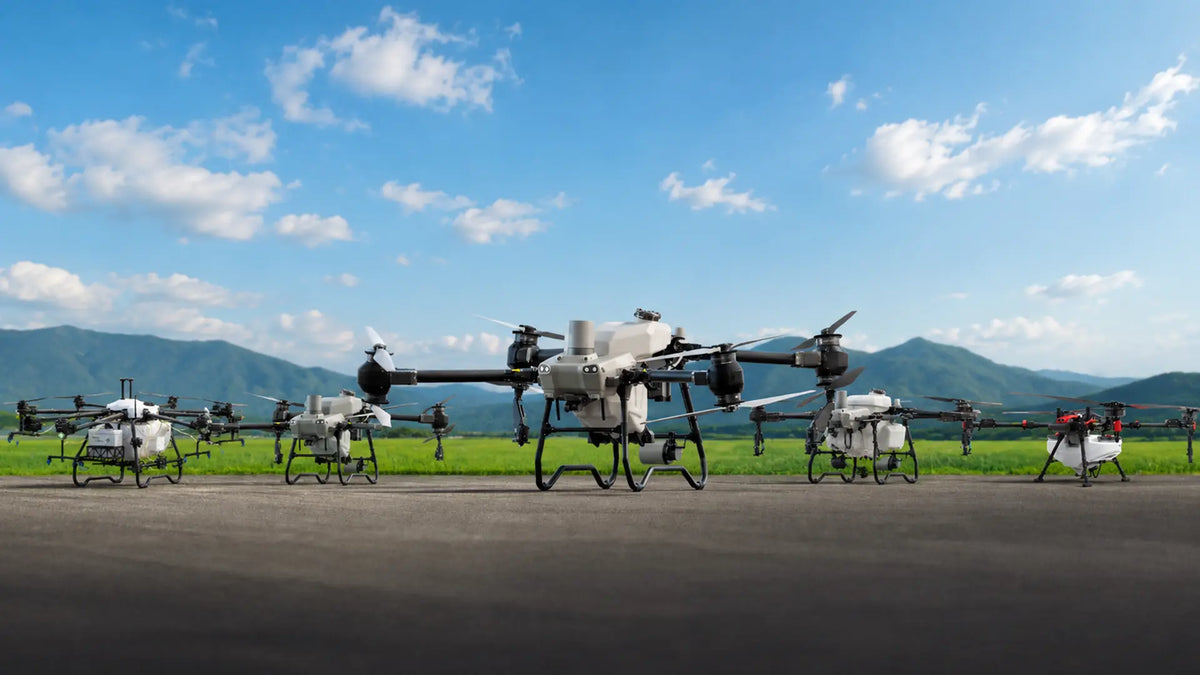
The infographic below provides a quick visual comparison of the eight featured crop spraying drones, making it easier to compare their relative size before exploring the detailed reviews and recommendations.

If you're not sure where to start, here's a quick way to narrow your options based on your operation and priorities.
| If you need... | Recommended Drone |
|---|---|
| The best overall balance of productivity and support | DJI Agras T50 |
| A compact drone for small to mid-sized farms | DJI Agras T25 |
| Maximum productivity for large commercial operations | DJI Agras T100 |
| Precision spraying and advanced automation | XAG P150 |
| A U.S.-made drone for high-capacity commercial spraying | Hylio AG-272 |
| Enterprise-scale autonomous spraying | EA Vision J100 |
| A compact U.S.-made agricultural drone | Hylio AG-230 |
| A proven precision agriculture platform with RTK automation | XAG P100 Pro |
Introduction
Buying a crop spraying drone has become more complicated than it was just a few years ago.
Manufacturers now offer larger payloads, stronger automation, and more capable agricultural platforms. It is easy to assume the biggest or newest drone is the best choice.
That is where many buyers make their first mistake.
Daily productivity depends on more than tank size. Battery workflow, refill time, dealer support, FAA requirements, and long-term ownership all affect how much work you can finish during a spray window.
This guide compares the eight best crop spraying drones of 2026 using real buying factors, not just product specifications. The goal is simple: help you choose the right platform for your acreage, workload, crops, and business goals.
Bottom line: Do not choose a spray drone based on payload alone. Uptime, support, and operating efficiency matter just as much.

How We Evaluated These Crop Spraying Drones
Not every crop spraying drone is built for the same operation.
A drone that works well on a small farm may not be the right choice for a custom applicator covering thousands of acres. We evaluated each platform based on practical buying factors that affect field performance and ownership.
We looked at:
- Spray performance and application consistency
- Spray capacity, productivity, and refill workflow
- Battery workflow and daily operating efficiency
- FAA operational fit and U.S.-based dealer support
- Software ecosystem, service access, and long-term ownership
- Best fit by farm size, crop type, and business model
No single drone is right for every farm. The best investment is the one that fits your actual operation.
Key takeaway: Bigger is not always better. The right drone is the one that keeps your crew productive with the least operational friction.
This guide is based on published manufacturer specifications, current U.S. product availability, FAA operational considerations, and DSLRPros' experience supporting enterprise and commercial drone deployments. Specifications should always be confirmed with the manufacturer before purchase because configurations and regional availability can change.
Which Crop Spraying Drone Should You Choose?
Before comparing models, define how the drone will be used on a normal workday.
Quick Tip: Don't choose a crop spraying drone based on tank size alone. Consider your acreage, battery workflow, dealer support, and long-term operating costs to find the best fit for your operation.
Ask these questions first:
- How many acres will you spray? Smaller farms may not need the largest platform. Commercial applicators often benefit from higher capacity.
- What crops are you treating? Row crops, orchards, vineyards, and specialty crops have different spray requirements.
- Are you spraying your own fields or offering custom application services? Higher workloads usually justify more capacity and stronger battery workflows.
- How important is local dealer support? Fast access to parts and service can reduce downtime during peak season.
- What is your real budget? Include batteries, charging equipment, maintenance, training, and compliance, not just the drone.
For most operators, the best choice comes down to total efficiency. A drone that fits your workload and support needs will usually deliver better long-term value than one with bigger specifications on paper.

The 8 Best Crop Spraying Drones of 2026
The U.S. crop spraying drone market has several strong options, but only a handful stand out for commercial agricultural use. These eight platforms are ranked based on performance, support, operating fit, and long-term value.
1. DJI Agras T50
Editor's Pick | Best Overall Crop Spraying Drone
The DJI Agras T50 is our Editor's Pick because it delivers one of the best combinations of productivity, operational efficiency, and versatility for commercial agricultural operations. Designed for medium to large farms and custom applicators, it combines a high-capacity spraying system with support for spreading and aerial surveying, allowing operators to perform multiple field tasks using a single platform. Backed by DJI's mature agriculture ecosystem, the T50 helps reduce downtime while improving day-to-day operational efficiency.
Beyond the aircraft itself, the T50 benefits from an established support network that includes intelligent flight planning, battery management, field operation tools, and U.S.-based dealer service. For operators working during narrow application windows, reliable parts availability and technical support can be just as valuable as payload capacity.
Key Specifications
Tank Capacity: 40 L spray tank (40 kg payload), 75 L spread tank (50 kg payload)
Maximum Spray Width: Up to 11 m (36 ft)
Maximum Spray Flow Rate: Up to 24 L/min
Battery: DJI DB1560 Intelligent Flight Battery (30,000 mAh)
Typical Price: Contact DSLRPros for current pricing and complete bundle options.
Pros
- 40 L spray tank and optional 75 L spreading system support multiple agricultural applications
- Up to 24 L/min maximum spray flow rate for efficient application
- Mature DJI Agriculture ecosystem with integrated flight planning and operations management
- Extensive U.S. dealer network for training, service, and replacement parts
- Excellent choice for FAA Part 137 agricultural operations
Cons
- Higher initial investment than smaller agricultural drones
- Best suited for medium to large farms and commercial applicators
Best for: Commercial farms, custom applicators, and agricultural businesses looking for the best balance of productivity, operational efficiency, and long-term support.
2. DJI Agras T25
Best for Small to Mid-Sized Farms
The DJI Agras T25 is an excellent choice for growers who need professional crop spraying capabilities in a compact, easy-to-transport platform. Designed for small to mid-sized farms, orchards, vineyards, and specialty crops, it delivers many of the advanced features found in DJI's larger agricultural drones while offering greater maneuverability in tighter field conditions.
Its smaller size makes transportation, deployment, and operation more manageable, especially for operators working across multiple properties or irregular terrain. While it cannot match the daily output of the Agras T50, the T25 offers an efficient and cost-effective solution for operations that do not require maximum payload capacity.
Key Specifications
Tank Capacity: 20 L (spraying), 35 L (spreading)
Maximum Spray Width: Up to 7 m (23 ft)
Maximum Spray Flow Rate: Up to 16 L/min
Battery: DJI DB800 Intelligent Flight Battery (15,000 mAh)
Typical Price: Contact DSLRPros for current pricing and complete bundle options.
Pros
- Compact and lightweight design for easier transportation between fields
- Well suited for orchards, vineyards, specialty crops, and small to mid-sized farms
- Shares DJI's proven Agriculture ecosystem with intelligent flight planning and operations management
- Lower initial investment than higher-capacity agricultural platforms
- Easy to deploy and operate in confined or irregular field layouts
Cons
- Smaller 20 L spray tank requires more refill cycles on large-acreage jobs
- Lower daily productivity than higher-capacity models such as the Agras T50
Best for: Growers with small to mid-sized operations, specialty crop producers, orchards, vineyards, and buyers looking for a professional agricultural spray drone that prioritizes portability and ease of use.
3. DJI Agras T100
Best for High-Volume Operations
The DJI Agras T100 is DJI's most advanced agricultural drone, built for operators managing large-scale commercial farming and high-acreage spraying programs. Designed to maximize daily productivity, it combines a larger payload, higher application rates, and expanded automation features to help reduce downtime across demanding agricultural operations.
In addition to spraying, the T100 supports spreading and aerial lifting, making it a versatile platform for multiple agricultural tasks. While its capabilities make it well suited for large commercial farms and custom applicators, smaller operations may not require this level of capacity. Buyers should also confirm product availability and dealer support within their region before purchasing.
Key Specifications
Tank Capacity: 75 L spray tank (75 kg payload), 150 L spread tank (100 kg payload)
Maximum Spray Width: Up to 10 m (33 ft)
Maximum Spray Flow Rate: Up to 30 L/min
Battery: DJI DB2160 Intelligent Flight Battery (41,000 mAh)
Typical Price: Contact DSLRPros for current pricing and complete bundle options.
Pros
- Large 75 L spray tank supports maximum daily productivity for commercial operations
- Up to 30 L/min maximum spray flow rate for efficient application across large acreages
- Supports spraying, spreading, and aerial lifting using a single platform
- Advanced DJI Agriculture ecosystem with intelligent flight planning and automation
- Built for demanding commercial agricultural workflows
Cons
- Higher investment than lower-capacity agricultural drones
- Capability may exceed the needs of small and mid-sized farming operations
Best for: Large commercial farms, agricultural cooperatives, and custom applicators that need maximum daily productivity, multi-function capability, and high operational efficiency.
4. XAG P150
Best for Precision Spraying
The XAG P150 is designed for growers and agricultural service providers that prioritize precision application, intelligent automation, and consistent performance across complex field conditions. Built for modern precision agriculture, it combines autonomous flight capabilities with advanced obstacle avoidance and terrain adaptation to help improve application accuracy while reducing operator workload.
The P150 is particularly well suited for orchards, specialty crops, and fields with uneven terrain where precise spraying is critical. Before purchasing, U.S. buyers should confirm local dealer availability, parts support, and service resources, as regional support networks may vary.
Key Specifications
Tank Capacity: 70 L spray tank
Maximum Spray Width: Up to 10 m (33 ft)
Maximum Spray Flow Rate: Up to 30 L/min
Battery: XAG Smart Battery System
Typical Price: Contact your authorized XAG dealer for current pricing and available package configurations.
Pros
- Large 70 L spray tank supports high-productivity commercial spraying
- Next-generation XAG platform designed for maximum daily field productivity
- Advanced autonomous flight with intelligent terrain following and obstacle avoidance
- Well suited for large farms, orchards, and complex field conditions
- Precision agriculture ecosystem designed to optimize spraying efficiency and operational workflow
Cons
- Dealer, parts, and service availability may vary by region
- Buyers should confirm local support before making a long-term investment
Best for: Commercial growers and agricultural service providers that need a next-generation high-capacity precision spraying platform for large-scale operations. .
5. Hylio AG-272
Best U.S.-Made Crop Spraying Drone
The Hylio AG-272 is one of the leading U.S.-made agricultural spray drones, designed for commercial growers and custom applicators that prioritize domestic manufacturing, regulatory compliance, and U.S.-based support. Built in Texas, it combines high payload capacity with autonomous flight capabilities, making it a strong choice for operators who want an American-built alternative to imported agricultural drone platforms.
Beyond its hardware, the AG-272 integrates with Hylio's AgroSol software and GroundLink controller to support autonomous flight planning and field operations. It is also NDAA compliant, making it an attractive option for organizations with domestic sourcing or procurement requirements.
Key Specifications
Tank Capacity: 18 gal (68 L) spray tank
Maximum Spray Width: 30–40 ft (9–12 m)
Maximum Spray Flow Rate: Up to 4.0 gal/min
Battery: Dual 14S 42 Ah (51.8 V) Intelligent LiPo Batteries
Typical Price: Contact DSLRPros for current pricing and complete bundle options.
Pros
- Designed and manufactured in the United States
- Large 18-gallon spray tank supports commercial agricultural operations
- Covers up to 50 acres/hour under manufacturer-rated operating conditions
- NDAA-compliant platform with U.S.-based support and service
- Autonomous flight planning through the Hylio AgroSol ecosystem
Cons
- Higher investment depending on configuration
- Software workflow may differ from DJI-based agricultural operations
Best for: Commercial growers, agricultural service providers, government organizations, and buyers looking for a U.S.-made crop spraying drone with domestic support and NDAA compliance.
6. EA Vision J100
Best for Large Enterprise Operations
The EA Vision J100 is a high-capacity agricultural spraying drone designed for large commercial farms, agricultural service providers, and enterprise-scale spraying operations. Built to maximize field productivity, it combines a large payload, intelligent autonomous flight, and advanced obstacle avoidance to help operators maintain efficient spraying across extensive acreage.
The J100 is particularly well suited for challenging terrain, including orchards, hilly landscapes, and irregular fields, where its AI-powered flight control and terrain-following capabilities help improve spraying consistency. For buyers managing large agricultural operations, it offers a strong alternative to other high-capacity commercial spraying platforms.
Key Specifications
Tank Capacity: 60 L spray tank
Maximum Spray Width: Up to 10 m (33 ft)
Maximum Spray Flow Rate: Up to 24 L/min
Battery: 30,000 mAh Intelligent Flight Battery
Typical Price: Contact your authorized EA Vision dealer for current pricing and available package configurations.
Pros
- Large 60 L spray tank supports high-volume commercial spraying
- AI-powered autonomous flight with intelligent terrain following and obstacle avoidance
- Well suited for orchards, mountainous terrain, and complex agricultural environments
- High-capacity platform designed for enterprise-scale agricultural operations
- Intelligent mission planning helps improve operational efficiency and spraying consistency
Cons
- Dealer and service availability may vary by region
- Buyers should confirm local support and parts availability before purchasing
Best for: Large commercial farms, agricultural cooperatives, and enterprise operators looking for a high-capacity autonomous spraying platform for demanding field conditions.
7. Hylio AG-230
Best Compact U.S.-Made Alternative
The Hylio AG-230 is a compact U.S.-made agricultural spray drone designed for growers who want professional spraying capabilities without moving to a larger, higher-capacity platform. Manufactured in Texas, it combines autonomous flight, precision application, and domestic support in a lighter, more maneuverable aircraft that's well suited for smaller farms, specialty crops, and custom applicators working across multiple locations.
Like the AG-272, the AG-230 integrates with Hylio's AgroSol software and GroundLink controller for autonomous mission planning and field operations. It is also NDAA compliant, making it a strong option for buyers seeking an American-built agricultural drone that meets domestic procurement requirements.
Key Specifications
Tank Capacity: 8 gal (30 L) spray tank
Maximum Spray Width: 20–30 ft (6–9 m)
Maximum Spray Flow Rate: Up to 4.0 gal/min
Battery: Dual 12S 16 Ah (44.4 V) Intelligent LiPo Batteries
Typical Price: Contact DSLRPros for current pricing and complete bundle options.
Pros
- Designed and manufactured in the United States
- Compact 8-gallon spray tank provides excellent maneuverability for smaller operations
- Covers up to 50 acres/hour under manufacturer-rated operating conditions
- NDAA-compliant platform with U.S.-based support and service
- Autonomous flight planning through the Hylio AgroSol ecosystem
Cons
- Lower payload capacity than larger commercial agricultural drones
- Better suited for small to mid-sized operations than large-acreage spraying
Best for: Growers, specialty crop producers, vineyards, orchards, and agricultural service providers looking for a compact U.S.-made crop spraying drone with autonomous capabilities and domestic support.
8. XAG P100 Pro
Best for Proven Precision Agriculture
The XAG P100 Pro is a commercial agricultural drone built for growers and service providers that prioritize precision application, intelligent automation, and efficient field operations. Combining autonomous flight, RTK positioning, terrain following, and obstacle avoidance, it delivers accurate spraying performance across a wide range of crops and field conditions.
Although newer XAG platforms offer larger payloads, the P100 Pro remains a capable solution for commercial spraying operations that value a mature precision agriculture ecosystem. Before purchasing, U.S. buyers should confirm local dealer availability, technical support, and replacement parts within their region.
Key Specifications
Tank Capacity: 50 L spray tank
Maximum Spray Width: 5–10 m (16–33 ft)
Maximum Spray Flow Rate: Up to 22 L/min
Battery: 20,000 mAh Smart Battery (962 Wh)
Typical Price: Contact your authorized XAG dealer for current pricing and available package configurations.
Pros
- Proven precision agriculture platform with a mature XAG ecosystem
- RTK positioning delivers highly accurate autonomous flight and repeatable mission planning
- Advanced terrain following and intelligent spraying improve application consistency
- Up to 22 L/min spray flow rate supports efficient commercial spraying
- Reliable choice for operators already invested in XAG hardware and software
Cons
- Dealer and service availability may vary by region
- Smaller payload than newer flagship agricultural drone platforms
Best for: Commercial growers and agricultural service providers looking for a proven precision agriculture platform with advanced automation, RTK accuracy, and intelligent spraying capabilities.
Crop Spraying Drone Comparison Table
| Drone | Best For | Specifications | Why Choose It | Things to Consider |
|---|---|---|---|---|
| DJI Agras T50 | Most commercial farming operations | 40 L tank • Up to 11 m spray width • Up to 24 L/min | Best overall balance of productivity, support, and long-term value | Higher upfront investment |
| DJI Agras T25 | Small to mid-sized farms | 20 L tank • Up to 7 m spray width • Up to 16 L/min | Compact, capable, and easy to transport | Lower spray capacity |
| DJI Agras T100 | High-volume operations | 75 L tank • Up to 10 m spray width • Up to 30 L/min | Maximum productivity for large-scale operations | Confirm U.S. availability |
| XAG P150 | Precision spraying | 70 L tank • Up to 10 m spray width • Up to 30 L/min | AI-powered autonomous precision spraying | Confirm local dealer support |
| Hylio AG-272 | U.S.-made platform buyers | 18 gal tank • 30–40 ft spray swath • Up to 4.0 gal/min | U.S.-made, NDAA compliant, autonomous operations | Compare workflow and operating costs |
| EA Vision J100 | Large enterprise operations | 60 L tank • Up to 10 m spray width • Up to 24 L/min | High-capacity spraying with AI terrain following | Confirm dealer support and parts availability |
| Hylio AG-230 | Smaller commercial operations | 8 gal tank • 20–30 ft spray swath • Up to 4.0 gal/min | Compact U.S.-made autonomous spraying platform | Lower payload capacity |
| XAG P100 Pro | Proven precision agriculture | 50 L tank • 5–10 m spray width • Up to 22 L/min | Proven RTK-enabled precision agriculture platform | Smaller payload than newer flagship models |
What Changed in 2026?
The crop spraying drone market in 2026 is evolving through operational maturity rather than dramatic technological breakthroughs. While manufacturers continue introducing larger platforms and new automation features, buyers are increasingly making purchasing decisions based on long-term productivity, operational efficiency, and support—not just payload capacity.

Three trends stand out this year:
- Higher-capacity platforms continue gaining traction. Newer agricultural drones are designed to cover more acreage with fewer refill and battery cycles, making them well suited for commercial farms and custom applicators managing large spray programs.
- Dealer support has become a key buying factor. As crop spraying drones become long-term business investments, growers are placing greater importance on access to training, replacement parts, technical service, and ongoing product support to minimize downtime during critical application windows.
- Automation is improving day-to-day operations. Features such as intelligent flight planning, terrain following, RTK positioning, and obstacle avoidance are helping operators achieve more consistent application while reducing manual workload across a wider range of crops and field conditions.
The biggest change isn't simply larger tanks or faster drones—it's how buyers evaluate value. Today's commercial operators increasingly compare total cost of ownership, including productivity, operational uptime, service support, and long-term operating costs, rather than focusing on specifications alone.
Questions to Ask Before Buying a Crop Spraying Drone
Before buying, define the operation first.
Ask yourself:
- How many acres will you spray each season?
- What crops will you treat?
- Will you spray your own fields or offer custom application services?
- Is dealer support available in your region?
- What will the total cost of ownership look like?
- Do you meet FAA and state requirements for agricultural spraying?
The clearer your answers, the easier it is to avoid buying a drone that is too small, too large, or too difficult to support.
Common Buying Mistakes
Buying a crop spraying drone is a significant investment. Avoiding these common mistakes can help you get better long-term value and reduce costly surprises after the purchase.
Choosing the biggest drone instead of the right drone
Higher capacity helps only when the workload supports it. For some operations, a smaller drone may deliver better ROI.
Looking only at purchase price
The drone is only one part of the investment. Batteries, chargers, maintenance, training, and support all affect the total cost.
Overlooking dealer support
A strong drone becomes a liability if parts or technical support are not available during spray season.
Ignoring FAA requirements
Commercial spraying requires more than owning a drone. Operators should understand the applicable FAA, state, and chemical application requirements before flying.
Key takeaway: The best buying decision is not always the cheapest or largest option. It is the platform that fits the workload and can stay productive.
FAA Requirements for Crop Spraying Drones
Commercial crop spraying with drones in the U.S. involves regulatory requirements beyond standard drone ownership.
Operators should be prepared for:
- FAA Part 107 Remote Pilot Certificate for commercial drone operations
- FAA Part 137 Agricultural Aircraft Operator Certificate for aerial application
- FAA registration and Remote ID compliance, where applicable
- Federal, state, and local pesticide or chemical application requirements
FAA requirements can vary by aircraft, operation, and materials dispensed. Before purchasing a spray drone, confirm which certifications and approvals apply to your operation.
Key takeaway: The drone purchase is only one part of the process. Compliance planning should happen before the aircraft is put into service.
Cost to Operate a Crop Spraying Drone
The purchase price is only part of the investment. Operating costs can have a larger effect on profitability over time.
Common costs include:
- Batteries and charging equipment
- Maintenance and replacement parts
- Operator training and certifications
- Insurance and compliance
- Software or fleet management tools, where applicable
Quick ROI Checklist
Ask yourself these questions before investing:
- ✅ How many acres will you spray each season?
- ✅ Will a drone reduce labor or equipment costs?
- ✅ Can faster application help protect crop yield during critical spraying windows?
- ✅ Will improved efficiency allow you to cover more acreage each day?
- ✅ Could the drone generate additional revenue through custom application services?
Estimating ROI
For many commercial operators, a complete crop spraying drone package—including the aircraft, batteries, chargers, trailer, and supporting equipment—can range from approximately $25,000 to over $80,000, depending on the platform and configuration. The following example illustrates how to estimate ROI using a hypothetical $60,000 investment.
Let’s use this as a simple starting point:
ROI (%) = (Annual Financial Benefit − Annual Operating Costs) ÷ Initial Investment × 100
Example calculation:
($40,000 − $10,000) ÷ $60,000 × 100 = 50%
Estimate Revenue per Hour
Estimated Revenue per Hour = Acres Sprayed per Hour × Average Revenue per Acre
Example calculation:
40 acres/hour × $12/acre = $480/hour
These are planning tools, not guarantees. Actual revenue and ROI depend on acreage, utilization, labor costs, operating expenses, and how often the drone is used.

What Most Buyers Miss
Many buyers compare payload, spray width, and price. Experienced operators look deeper.
Downtime can cost more than the higher investment
A lower-priced drone may become more expensive if replacement parts or technical support are unavailable during peak spraying season.
Daily workflow matters more than maximum capacity
A larger tank does not automatically mean more acres per day. Charging, refilling, transport, and field logistics all affect output.
Buy for the next five seasons
A crop spraying drone is a long-term asset. Consider whether the platform, software, and support network can keep up as your operation grows.
Software ecosystem matters
Some platforms integrate more smoothly with mapping, fleet management, mission planning, and operational recordkeeping than others. If you manage multiple aircraft or crews, software compatibility can affect efficiency just as much as aircraft performance.

Final Recommendation
There is no single crop spraying drone that's right for every farming operation. The best choice depends on your acreage, crop type, application volume, terrain, budget, and long-term support requirements.
For most commercial growers and custom applicators, the DJI Agras T50 remains our top overall recommendation because it delivers an excellent balance of productivity, operational efficiency, and dealer support. However, buyers should choose the platform that best matches their workload rather than simply selecting the largest or newest aircraft.
If you operate smaller farms or specialty crops, the DJI Agras T25 may be the better fit. For maximum daily output on large-scale operations, consider the DJI Agras T100 or EA Vision J100. Buyers seeking a U.S.-made platform should evaluate the Hylio AG-272 or AG-230, while operators focused on precision agriculture may prefer the XAG P150 or P100 Pro.
The best long-term investment isn't necessarily the drone with the largest tank or the highest payload—it's the one that fits your operation, keeps your crews productive, and is backed by reliable training, service, and technical support.
Frequently Asked Questions
What is the best crop spraying drone in 2026?
For most commercial operators, the DJI Agras T50 is the best overall crop spraying drone because it balances productivity, field performance, and U.S.-based dealer support.
How much does a crop spraying drone cost?
Most professional crop spraying drones cost between approximately $15,000 and more than $80,000, depending on payload capacity, batteries, charging equipment, accessories, and bundle configuration. Complete commercial packages cost more than the aircraft alone, so buyers should evaluate total ownership costs instead of sticker price.
Do I need an FAA license to spray crops with a drone?
Yes. Commercial agricultural spraying typically requires a Part 107 Remote Pilot Certificate, Part 137 authorization, FAA registration, and applicable state or chemical application compliance.
Which crop spraying drone is best for small farms?
The DJI Agras T25 is a strong option for many small to mid-sized farms because it offers professional spraying capability in a more compact platform.
Are U.S.-made crop spraying drones available?
Yes. Hylio manufactures professional agricultural spray drones in the United States, including the AG-272 and AG-230.
Find the Right Crop Spraying Drone for Your Operation
Need help choosing the right crop spraying drone? Our agricultural drone specialists can help evaluate your acreage, workflow, and operational requirements to recommend the best platform for your operation.
Explore the DJI Agras T50 Complete Bundle or contact DSLRPros to get started.